
Things to Consider if Sac Must Close
This is part three of a four-part series preparing for a possible Sac closure announcement. Find the rest of the series linked here.
I don’t want to tempt fate by writing about closure as if it’s a foregone conclusion. And to repeat myself once again, closure has not been proposed at this time.
If Sac does wind up closed, though, the questions about what happens afterward need to be resolved while the closure is still being discussed. The better prepared we are going into that conversation, the more likely we are to secure outcomes that benefit our community.
Preparing for a positive closure outcome doesn’t mean we’re giving up on Sac. It means we’re preparing for all eventualities.
Here are three things I want to fight for if Sac must close:
1. I want families to get a better future than the one we’re losing.
Maybe that translates to priority enrollment at any other SPS school, including dual language, etc. Maybe a better future includes guaranteed bus transportation for some number of years, too. Maybe it looks like allowing families to select into buddy groups who will be guaranteed enrollment in the same school together through the end of their families’ elementary years.
Maybe a better future includes distributing Sacajawea’s teaching staff as directly as possible to the site(s) that are gaining the most former Sac students.
It’s likely that a better future involves active planning and engagement—supported with a budget—to integrate Sac students into their new communities, especially in places where large cohorts of Sac students land.
Choice priority will be especially important for Sac’s special ed students. We have a disproportionate number of special ed kids here precisely because this population is already so frequently excluded from their neighborhood schools. Sac is the place they’ve ended up because Sac has the supports they need. Many of these students also have a more-difficult-than-average time adapting to change. Let’s find them alternate educational homes that they can rely on for the long term, without further disruptions.
The ingredients for a better future will differ for different families. This is a community discussion we need to have, and we can start having it before any closure is even announced. We need to figure out as a community what we most want to advocate for.
2. I want a plan for the empty building that respects the neighborhood.
By far the most common outcome for closed schools nationwide is that they sit abandoned and fall into disrepair from lack of maintenance and vandalism. Here’s a spoiler from a beautiful, visual article that chronicles the outcomes for the 46 buildings that Chicago public schools closed in 2013: Over half of the buildings still sit abandoned.
Nobody wants this for Sac.
The time to apply pressure for a better building use is during, and even before, the closure discussions. Afterward is too late.
At the very minimum, I want the playgrounds to be publicly accessible and maintained. This should be a given, but even with Sac in operation, we’ve had to apply pressure to keep the outdoor spaces unlocked in the evenings and on weekends. We cannot let a school closure add insult to injury by permanently closing off or privatizing existing public play spaces.
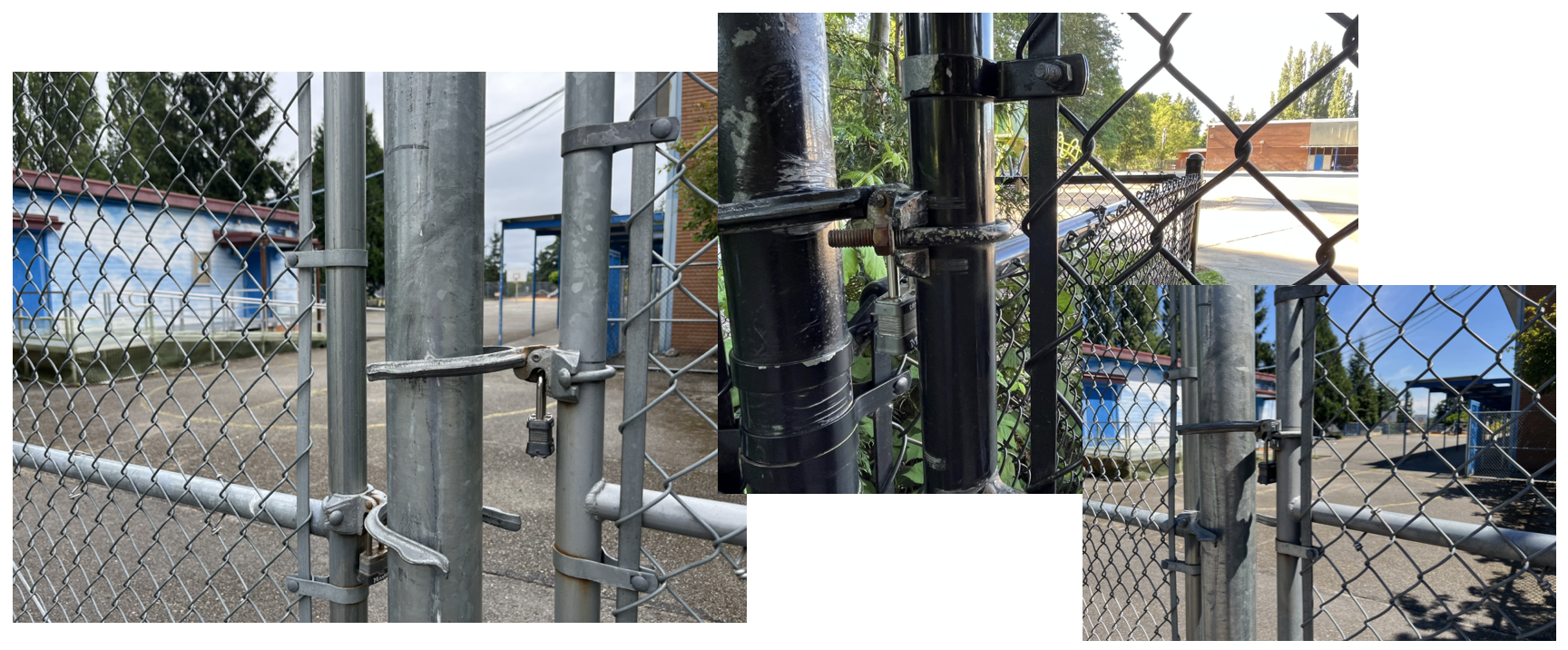
Photos of the Sacajawea playgrounds locked against public access. Photos were taken on weekends and evenings in June 2026, when neither the school nor the on-site Boys & Girls club were in operation. This is not a long-term future I want for our neighborhood.
Even better, I’d like to see the building itself be useful. There are a few ways that this might happen, but none of them seem likely¹. Any tenant who might want to buy or lease the space is likely to require renovations, which are costly—or, if they aren’t, maybe someone can explain to us why Sac hasn’t seen any in 75 years. Demolition is expensive and forecloses the possibility of a future remodel and reopening by SPS.
Importantly, any guarantees that SPS makes about maintenance, demolition, renovations, rental to community groups, or anything else must be reconciled with the arguments they are making about closures saving money. The logic has to be consistent for the public (that’s us!) to believe that any promises will be kept.
Bonus read: I found this short article to be extremely valuable in shaping my thinking about what can happen to the property when a school building closes.
3. I want a commitment to boundary updates and long-term facilities planning.
Sacajawea is in this situation because the district failed, for decades, to support the basic maintenance needs of our building. The construction of a brand-new Hazel Wolf one mile away, without any boundary adjustments, began draining Sac’s population. The 2024 closure threat and the cancellation of our planned rebuild are just the latest blows in a long series of decisions made without foresight.
SPS’s elementary building utilization is low (65% in 2024) because the district keeps building elementary schools with a capacity of 500-650 kids in an environment of declining enrollment—and, again, without adjusting attendance zone boundaries to compensate for the huge increases in capacity.
Whose job is it to change these patterns? It’s the board’s job, and I want them to do it. They should be doing this already, and indeed, some board directors (most visibly, Jen LaVallee and Vivian Song) are working toward expanded facilities planning. Any closures announced this year will precipitate a new level of urgency for long-term planning—and a degree of public attention that can be leveraged to get this planning accelerated and into the public discussion for future accountability.
We may not be able to save ourselves, but we might save other communities from the same slow death spiral that Sac is enduring right now.
A last note on boundary changes: They sound disruptive, but they generally aren’t! It is common practice for students to be grandfathered into their current school, even if boundary changes would otherwise assign them to a different one. Put another way, boundary changes generally apply to incoming families, but don’t affect students already enrolled.
This grandfathering approach is, in fact, the current SPS policy, though the last time SPS updated its attendance area boundaries meaningfully was in 2013.
***
If Sac were to be closed, what would you want to see happen to the building and the school community? Drop me a line at advocacy@sacpta.org. And jot a note down to bring to the closure prep meeting(s) that I’ll be organizing later this summer.
Whether it’s a campaign to save Sac, or the shaping of a closure outcome that is minimally disruptive, or just getting adequate staffing levels for a school of our size, I think there is a real struggle coming this year.
Join me in the next—and last—part of this series, where I discuss the sources of our community’s power. This is what gives us the strength to influence outcomes for whatever version of a struggle we may face in the fall.
Or, jump to any part of the series from its intro or using these links:
Things to consider if Sac must close (you are here)
FOOTNOTE
¹Per Washington state law, charter schools have the right of first refusal to purchase or lease a closed public school property at market value. There are three charter schools currently operating within SPS boundaries who would be eligible to buy or lease Sac’s property, as far as I am aware.
Rainier Valley Leadership Academy (RVLA), is a K-12 charter school currently operating in Rainier Valley. IMPACT | Salish Sea Elementary is a charter K-5 in South Beacon Hill. Summit Public Schools operates a charter high school site called Sierra in the International District and a charter 6-12 site called Atlas in West Seattle.
RVLA is an independent school, but IMPACT and Summit Public Schools are affiliated charter districts with at least five locations each. They have experience opening new locations.