
Mapping Our Community Power & Leverage
This is part four of a four-part series preparing for a possible Sac closure announcement. Find the rest of the series linked here.
If a Sac closure is announced this year, we’ll certainly have advocacy work on our hands. Maybe the work will be a campaign to stay open, or maybe it’ll be a struggle to shape the terms of closure in a way that makes sense for our community. Maybe it will have to be both simultaneously.
In the absence of a closure announcement, we will have to advocate for adequate resourcing: music education, class sizes that meet district standards, and, if we’re feeling very powerful, perhaps some basic facilities maintenance!
In any case, advocating successfully requires power and leverage. Where is the Sac community’s power? What is our leverage, especially in a closure situation?
The source of our power is us. It’s cheesy, sure, but it’s true. If we hadn’t fought against the 2024 closure attempt, Sac would be closed today. It was the exercise of our power that changed that outcome.
We get our power from our numbers, our skills, and our relationships. An entire community can’t be ignored the way a single individual can. Our collective skills amplify our power, and between us we have many skills: communication, data analysis, storytelling, hope kindling, sign making, rally organizing, relationship building, and neighborhood canvassing. That doesn’t even include the skills we have to deploy in support the people doing this work—with childcare, food, and the moral support of a listening ear.
Relationships matter here, too. We have relationships now with families across the city who opposed the 2024 closures. We are organized, in the very concrete sense that involves email lists and Slack groups and community meetings and experience working together and shared trust. That is power.
We have a lot of power. The question will be how we use it.
***
Without any official authority, public pressure is our primary tool.
The purpose of public pressure is not to beg for a different outcome and hope that the people in charge change their minds because our stories are so compelling. No.
The purpose of public pressure is to change conditions so that those with authority find it easier to deliver our desired outcome than to stick with their original plan.
Successful public pressure campaigns are not exercises in begging. They are exercises of power.
Successful advocacy against closures, then, looks like building enough public resistance to closures that they are no longer worthwhile to district leadership. I use “building” intentionally here: doing this requires serious organizing.
The scales of power tip when the superintendent and board start worrying about losing their jobs or elections, or worrying that they’ve lost sufficient public trust to do their work effectively, or worrying that the dominant public narrative is personally uncomfortable or damaging.
The tipping point is situational. In 2024, with an already weak superintendent poorly supported by the board, it was easier to tip the scales than I think it would be this fall. But that doesn’t mean it’s impossible.
***
So, what leverage do we have to create a successful public pressure campaign opposing closures?
We have more than you’d think, largely because of the public discussions surrounding the 2024 attempted closures.
Superintendent Shuldiner, for example, is on the record stating that any future closures will be done with better community engagement than before. From KUOW in May:
In [Superintendent Shuldiner’s] view, the district made two critical mistakes back then. Top of the list: The dreaded “closure list.”
Shuldiner said that list appeared to be made “by fiat,” in a process that didn’t include the community, and he apologized the district was not “open, transparent, or even collaborative around these things.”
“We have to be really thoughtful about how we’re making decisions with the community,” he said, “not without the community.”
Those statements create leverage¹.
If a 2026 closure process begins with a list made “by fiat”, our organizing task becomes one of highlighting the loss of public trust—the cost to Shuldiner—that such a reversal incurs. Why should the city trust a leader who says one thing and does the opposite?
Shuldiner has led from the beginning with core themes of transparency and engagement. This has been good for the district and is appreciated by many, including me. I hope—and I actually do anticipate—that this style of leadership continues. If it doesn’t, though, a retreat from his stated principles does make Shuldiner vulnerable.
***
Several members of the board are also on the record regarding school closures. Their statements present opportunities to build pressure in a future closure situation.
Director Smith’s 2025 campaign website, for example, says of closures:
To better engage the community, SPS must amend its Closure Policy, SPS 6883. Right now, the policy begins with the Superintendent’s recommendation and analysis, treating public engagement as an afterthought. That must change. Engagement with communities should be the first step, not a formality after decisions are made.
Has Smith taken any steps to change policy 6883 since she joined the board eight months ago? Has there been any public engagement related to upcoming closures? If not, that’s an opportunity to apply pressure, especially because it is clear that the board is now actively involved in discussions about closures mergers.
Smith is filling a temporary board vacancy and will have to rerun for her seat in 2027 if she wants to continue on the board.
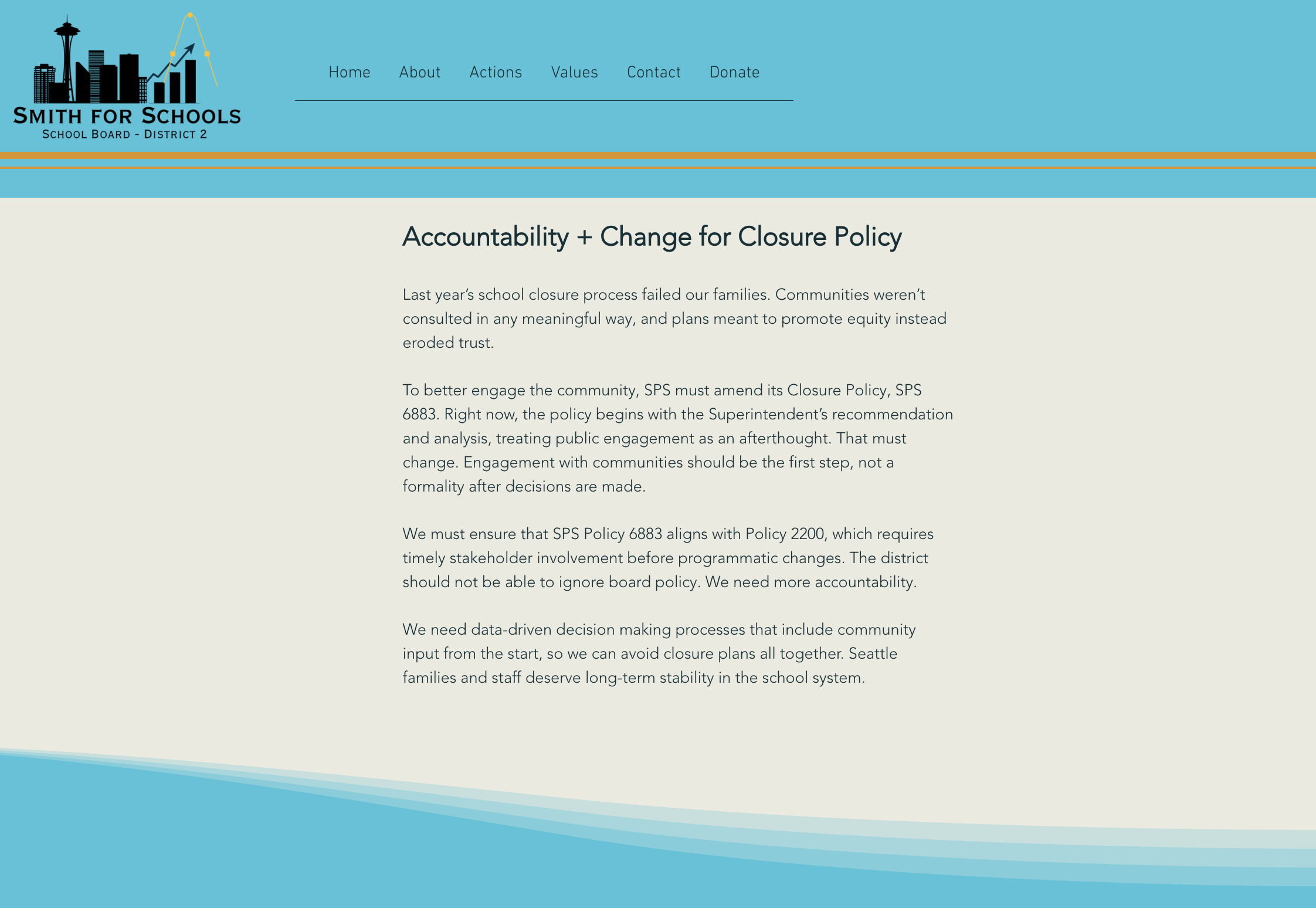
A screenshot of Director Smith’s campaign website from 2025, in which she outlines her position on school closures. The site, smithforschools.org, has since been taken down.
Director LaVallee’s campaign website reads, on closures, “Any closures should only be considered through meaningful partnership with affected communities, prioritizing student needs over financial calculations.” We can hold her to that.
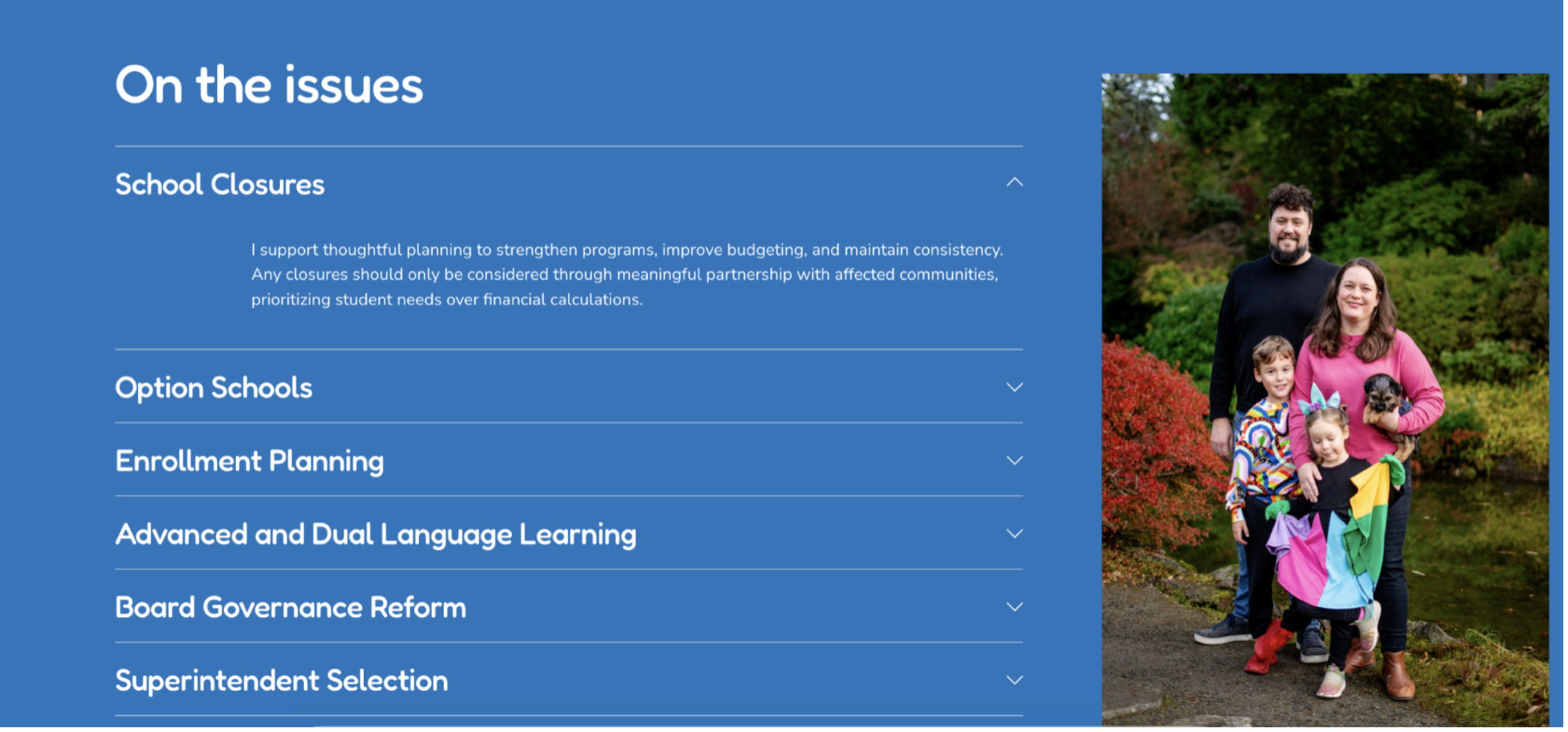
A screenshot of Director LaVallee’s campaign website from the 2025 election, in which she outlines her position on school closures.
Finally, who can forget the tearful, ten-minute speech given by then-President Rankin about how frustrated she was by the 2024 closure plans (after she advocated² for those same plans months earlier)? Rankin continues to believe that closures are necessary—she even ended that very speech with the phrase, “I’m not saying we don’t need to consider consolidations still...”
However. When it comes to Sacajawea specifically, here’s what she said that night:
What if we kept that [special education] model that they [Sacajawea] have that's so incredible and what if we use it as an asset to train more educators in inclusionary practices?
What if we built that school? What if we rebuilt that school at 300 or 350 so that educators could go there for two years and then take those best practices out into other buildings?
What if, indeed? If Sac comes under closure pressure again, Rankin needs to back up her words with action—or face the loss of trust that comes from not doing so.
***
Thanks for joining me over these past weeks in thinking about what Sac’s future might look like and how we want to shape it!
I will be organizing a casual community meeting soon, where we can talk about all of this over snacks. Everyone will be welcome.
Yes, you! Please join us! It doesn’t matter if you’re new to Sac or have been around for years. It doesn’t matter whether you were involved in the 2024 closure pushback or not. If you want Sac to stay open, please join us. If you think Sac is better off closed, please join us. If you don’t care either way (yet), you should still join us! The purpose of this meeting is to get a feel for where the community’s mind is on all of these interrelated issues, and to educate one another.
There will be no agenda, per se, but here are the core questions I expect to come up naturally at this gathering. Bring your own, too!
What does the majority of Sac’s population want for Sac’s long-term, stable future? A closure? A rebuild? Something else?
If a Sac closure is announced in 2026, what themes would we like our community response to include?
If Sac is closed, what do we want to see happen to the Sac building and property? What outcomes do we especially want to avoid?
What skills can each of us contribute to getting the outcomes we’d like? What are people’s energy levels like right now, about these issues?
If closures are announced in 2026 and, for some reason, they don’t include Sac, what would we like our community response to be? What does solidarity look like in this case?
I hope to see you soon!
If you missed any of the previous entries in this series, you can jump to them from the intro or using these links:
Mapping our community power and leverage (you are here)
FOOTNOTES
¹The statements are also good leadership. I’m preparing us for a hypothetical fight in this series, and I’m ready to have it. But I’m also holding space for the district’s new leadership to surprise us. Maybe hypothetical fall closures really would be considered with community involvement, and then introduced in a way that meaningfully engages families and is transparent and well-reasoned. Maybe closures aren’t imminent. One never knows!
²The original article was removed from KUOW’s online archives at some point in July 2026. I can’t say or speculate as to why.