
What has Changed Since the 2024 Fight to Save Sac
This is part two of a four-part series preparing for a possible Sac closure announcement. Find the rest of the series linked here.
In 2024, the campaign to save Sac was a defensive one. We fought to defend our building against SPS leadership's decision to close it. And we won!
In 2026, a campaign to save Sac will have to be an affirmative one. It is no longer enough just to keep the building open. This community is already in decline¹ without a stable vision for the future, and a stable vision cannot be built around a facility that has been described as “at the end of its life” for over a decade.
***
Saving Sacajawea requires securing concrete plans for a rebuild. That’s a tall order, but not an impossible one.
Here are some factors influencing the likelihood of securing rebuild plans:
First, Superintendent Shuldiner has paused planning for new construction for the time being, as explained here. Overall, I believe this is a good thing for the district. I share his belief that our newest buildings prioritize architectural showcasing over student-focused functionality.
The continued construction of giant new elementary schools with a capacity of 500-650 kids, in an environment of declining enrollment, without redistricting or long-term enrollment planning, is a major part of how Sac has ended up neglected and in decline. So in that context, too, a pause on new construction is beneficial.
Of course, a pause on new construction doesn’t bode well if Sac’s future requires rebuilding. That said, many construction projects are still underway, and it would not be unreasonable to get Sac back into the queue.
Second, a Sac rebuild would support only 300-350 students. I think 300-350 is a perfect size for an elementary school, but the district disagrees (as demonstrated by the string of recently-built mega schools). Generating district support for a rebuild of smaller size will require upending the narrative that smaller schools are more expensive to operate. That’s a narrative that Superintendent Shuldiner has espoused, in the SPS setting, as recently as this spring.
Even if rebuilding Sac at a larger size made practical sense (it doesn’t), it’s not possible. The early design phase of the rebuild, before that future was canceled, showed that Sac’s physical location cannot support a school with a capacity for more than 350 students.
Third, when the 2024 closures were announced, Sacajawea had been actively engaged in rebuild planning, and we were the presumptive candidate for the BEX VI levy money to rebuild an elementary school in the Northeast.
None of that is true any longer. The early design plans still exist, but they’ve stagnated. The BEX VI levy was passed in early 2025 with language stating only that money will go to the rebuild of “a Northeast elementary school.”
Sac can certainly fight to become that school! But let’s make no mistake that being named for rebuild is a possibility, not a presumption. There are other Northeast elementary schools that also need help. Wedgwood in particular is in a shape nearly as bad as Sac’s. It has larger, more stable enrollment than Sac, and it is located reasonably for a long-term investment.
***
Even if the struggle were only about keeping Sac open, the dynamics would differ significantly today from those of the 2024 struggle.
Most significantly, we have a new superintendent who was hired specifically to make difficult choices. He was selected by the board, and he has their backing.
By contrast, at the time the last round of closure attempts was resolved in November 2024, then-Superintendent Brent Jones had lost significant board support. The reasons for this, when that same board had unanimously approved a two-year contract extension for Jones one month before, in October, are a story for another time.
Superintendent Shuldiner currently has a high degree of public goodwill. He has shown up, frequently and publicly, to lead and also to listen, in ways that Jones never did.
Shuldiner even met with a group of Sac parents here in our library within a month of starting his job. He visited again during the school day this spring to meet with staff and students. If he makes a decision to close Sac, he can’t be accused of closing an anonymous school that he’s never visited, as Jones did.
Shuldiner has also stuck to the difficult decisions he has made so far—the most controversial one being his placement of Anitra Jones as principal at Adams Elementary, which sparked a huge and ongoing parent outcry.
Another potential difference from 2024 could be how a closure plan is developed and executed. Shuldiner himself has acknowledged that the 2024 process was a textbook example of what not to do.
If Sac’s community is meaningfully engaged before and during a closure process—that is, if Sac families are offered alternative futures that are truly attractive to us—then perhaps there would be no struggle at all. That would be frustrating for folks who oppose closures under any circumstances, but it might be satisfying enough for families who just want reasonable educational options for their kids.
One final, major difference between 2024 and today is that we, the community, have been here before. We know now how the district works. We know now how to scrutinize budgets and financial arguments. We have internalized the heaps of national research showing that closures don’t save money, a finding that has been reproduced over and over, including yet again last month.²
We now have relationships with families at the other schools that were targeted in 2024. We know what solidarity looks like. We know how to organize protests at JSCEE. We know how to testify at board meetings, pressure our local legislators, and reach the press.
We know how to fight.
Join me in part three of this series, where I discuss how we might use our power to get better outcomes, even if the final outcome is a closure of Sac.
And stick around for part four, where I highlight the sources of our community power and give a few ideas on how we can leverage it.
Or, jump to any part of the series from its intro or using these links:
What has changed since the 2024 fight to save Sac (you are here)
FOOTNOTES
¹ Sac’s enrollment has declined significantly since the attempted closure in 2024. The decline is particularly pronounced for next year, likely because the expansion of the SPS choice enrollment programs increased opportunities for families to enroll at buildings with less uncertain futures.
It’s not just Sac, either. The other schools that faced closure in 2024 are also losing students at a disproportionate rate (see below). We can’t know for certain, but I believe the uncertainty about the futures of these schools plays a big role in their decline.
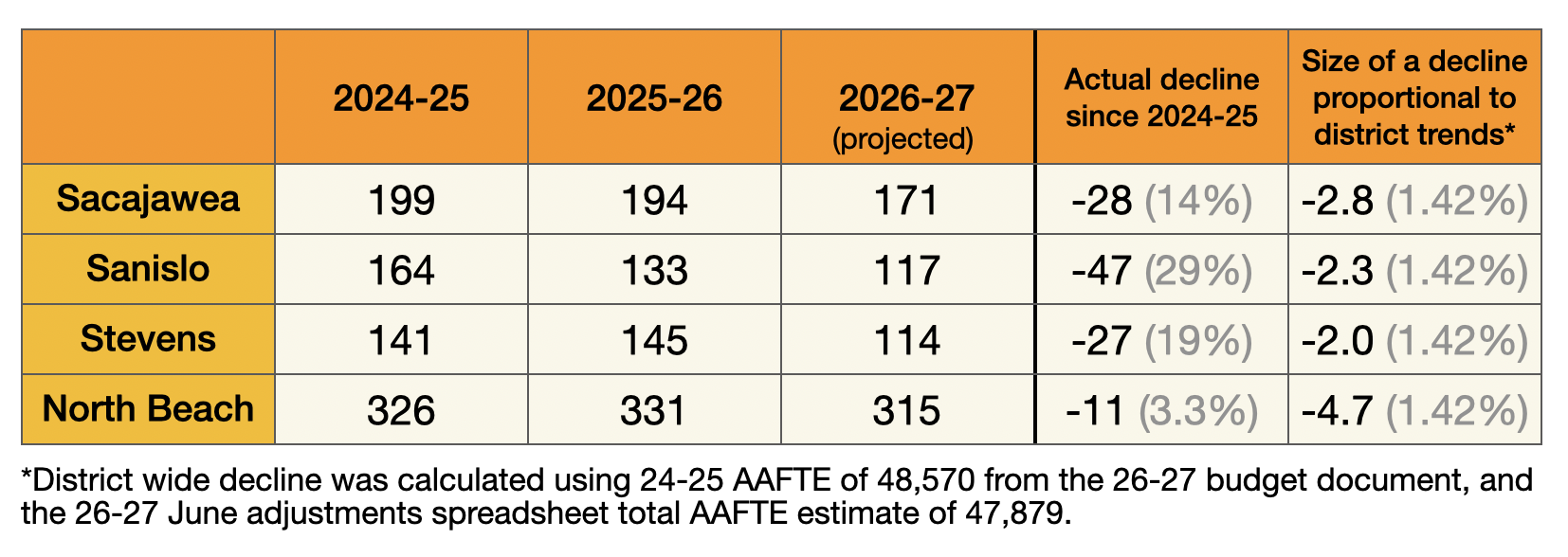
Enrollment histories for the four schools that faced concrete closure plans in 2024. All of them have lost a disproportionate number of students compared to the average district enrollment declines since 2024.
²Financial arguments for closing a school rarely make sense. District forecasts often omit costs like student transportation to more distant sites, maintenance and security of the closed building, enrollment decreases from families who leave the district when their site is closed, and the cost of preparing a building for rental or sale.
I am not planning to cover the many financial studies of past closures, and how they fail to save money, in this series. I will revisit this if the need becomes acute.