
Why a Sac Closure Proposal Seems Likely This Fall
This is part one of a four-part series preparing for a possible Sac closure announcement. Find the rest of the series linked here.
Once again, a disclaimer: As of this writing, SPS has not made any closure announcements. Not for Sac, and not for any other SPS school, either.
But.
There are plenty of signs that closure announcements are likely this fall. The most obvious one is the fact that the board and superintendent discussed the benefits of school mergers on June 13.
Before we get to that, though, let’s go back to some of the early warning signs of closures so we can see how they’re accelerating.
Since the first day of his tenure as Superintendent, Ben Shuldiner has been clear that closures—along with all other money-saving options—are on the table. He said it on Feb 5 (his fifth day on the job), and he’s repeated it often, including on May 14 and as recently as June 17.
In Shuldiner’s March 29 Sunday newsletter, he lists five things in the district that are “not-so-good.” The list begins:
brand new, beautiful school buildings half or even 2/3 empty,
old and dilapidated buildings close to capacity,
It’s difficult not to see the threat to Sac written between the lines here. Recall that the population of old and dilapidated Sac was slated to merge in 2024 into the brand-new, beautiful building of John Rogers, which is currently at less than half capacity. Indeed, parents rallied against closures this April after they found the subtext in Shuldiner’s newsletter alarming.
In a May board meeting, Shuldiner introduced the narrative that smaller schools are more expensive to operate. That’s a bad omen for little ol’ Sac, even though his analysis showed that our school’s costs are perfectly average.
Shuldiner thinking in these terms puts Sac at risk whether the merits of the cost/size argument are true or not. Sac is projected to be the fifth-smallest of the 55-60 SPS elementaries operating next year. At 171 students, we will only have more kids than Licton Springs (36), Stevens (114), Sanislo (117), and Sand Point (141).
In June, Shuldiner started openly shopping the idea of shutting down schools. He studiously avoids the term “closure,” opting instead for “merger,” but either verb has the same effect of displacing kids and shuttering buildings.
Shuldiner introduced the merger conversation in a board retreat slide, shown below. It estimates potential financial benefits of school closures—sorry, mergers—as being $1 million - $2.5 million per school. Community analysis from SPS's attempted closures in 2024 indicates that closures would yield savings of $600,000-$700,000 per school.
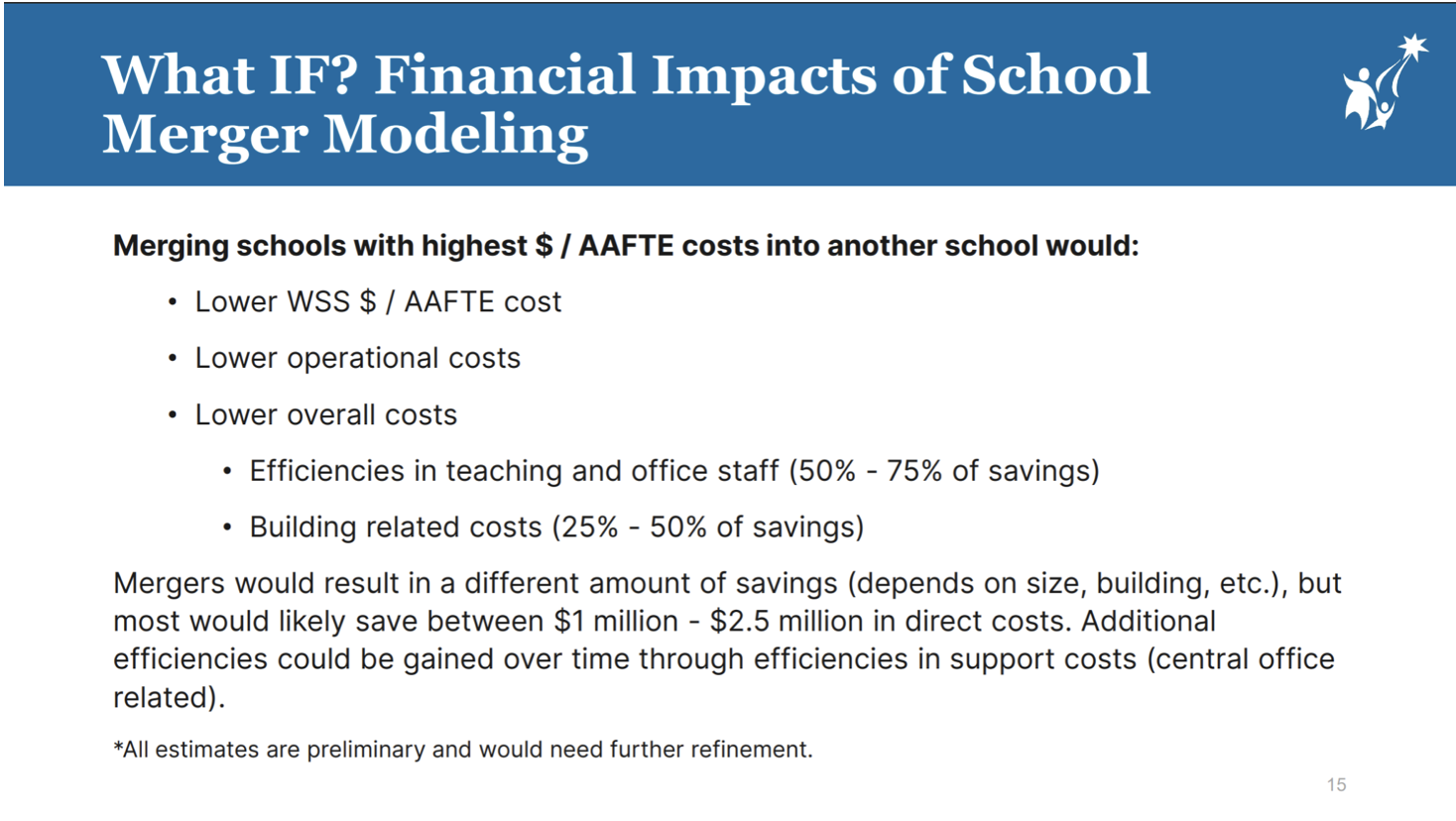
Slide from a board/superintendent work session on June 13, 2026, estimating the financial savings from hypothetical future school mergers.
Once again, though, the narrative doesn’t have to be true in order to motivate or justify a closure. In any case, it’s clear now that closures are being actively evaluated by SPS leadership.
***
If SPS pursues closures, Sac is particularly vulnerable.
In 2024, district leadership was perfectly willing to highlight the decrepit state of our building without taking accountability for the neglect that led us here. They cited our low enrollment without regard for the fact that it’s the district’s own policies that have drawn families elsewhere—and sadly, that flight has only accelerated since, which is why we lost two teachers and music for next year. In 2024, the district also highlighted our proximity to other new, empty elementaries without any reflection on their having constructed these large new buildings (John Rogers and Hazel Wolf in particular) in the first place.
We are small in both enrollment and building capacity, which are factors drawing Shuldiner’s and the board’s attention during budgeting exercises.
The community we have here is vibrant and close-knit, but that doesn’t translate into any of the metrics used for budgeting or facilities planning.
I will once again point out that these vulnerabilities—declining enrollment, crumbling building—are our problem, but they are not our fault. They are the result of district choices: The choice to build Hazel Wolf in our backyard without adjusting zoning, the choice to delay the Sac rebuild without a facilities plan in place, the choice to put our community through the ongoing uncertainty created by the 2024 closure threats, and the choice to leave us unsupported and with an uncertain future in the years since.
***
Here’s the final kicker: If Sac is to survive, simply avoiding closure isn’t enough. Our building is toast, as the kids say. It’s cooked. Keeping Sac open, in any sustainable way, requires a rebuilt facility.
Join me in part two of this series, where I discuss how the conditions of a struggle to keep Sac open have changed between 2024 and today.
Or, jump to any part of the series from its intro or using these links: