
Sacajawea PTA News
The happenings around Sacajawea
MLK Day 2024 Marching Resources for Sacajawea Families
All the details you need to join Sacajawea at the 2024 MLK March. We’d love to see you there!
What’s Happening?
We will meet at the Garfield Community Center playground on Cherry Street at noon. To take public transit, we recommend taking light rail to UW Light Rail Station (or parking at UW; free for the holiday), then taking bus route 48 (leaving from NE Pacific St & Montlake Blvd NE, across from the stadium). Get off at 23rd Ave & E Cherry St and walk to the playground across the street. From the playground, we will join the 12:30 pm march from Garfield High School. If you only want to march halfway and you took public transit, you can stop at Cal Anderson Park and take the light rail back to UW. If you march the whole way (about 2 miles) and join the rally at the end, you can take the light rail from Westlake.
What Should You Bring?
Overdress for the weather and bring lots of snacks for kids. Bring ORCA cards or cash for public transportation. Bring signs, musical instruments such as drums or other fun noise-makers, and wear your Sacajawea/BLM t-shirt. The march will be very family-friendly!
If you are still a little nervous about bringing your small folks, check out these tips:
http://parentstogetheraction.org/2017/01/13/10-tips-marching-safely-successfully-kids/
https://www.huffingtonpost.com/entry/11-tips-for-protesting-with-kids_us_587d41dae4b0740488c3ddbf
What Will We Bring?
We will take a group photo before the march starts; Day of contact; Mandi Grover; 206-612-3689
We will have markers to write parent phone numbers on kids' arms (just in case!)
We will have a few extra snacks and drinks to share
Recommended Books and Media for Preparation
YouTube also has read-aloud books and clips such as:
The Story of Martin Luther King Jr. https://www.youtube.com/watch?v=oJ8Xqzb2XSU
Martin’s Big Words https://www.youtube.com/watch?v=qBKP6v3rWSI
My Brother, Martin https://www.youtube.com/watch?v=5xmYleKG_HA
My First Biography of Martin Luther King Jr. https://www.youtube.com/watch?v=1artaZZrKeQ
My Daddy Martin Luther King Jr. https://www.youtube.com/watch?v=-dPRLCTWceQ
Great for elementary age https://www.youtube.com/watch?v=k6Au81aHuSg
Ideas for Slogans and Signs
Choosing simple, child-friendly slogans makes it easier for your kid to relate to the purpose of the march. Here are some ideas, but feel free to create your own! You can also print designs from websites like Amplifier or the MLK March website.
I love naps but I stay woke (for babies and toddlers)
Black Lives Matter
Kindness counts
Books not bullets
We the people
Unity, Equality, Justice
Racism isn’t born, it’s taught
Future voter
Another ideas is to put a quote from MLK on your sign:
Injustice anywhere is a threat to justice everywhere.
In the end, we will remember not the words of our enemies, but the silence of our friends.
Our lives begin to end the day we become silent about things that matter.
I have decided to stick with love. Hate is too great a burden to bear.
Character is how you treat those that can do nothing for you.
Those who love peace must learn to organize as effectively as those who love war.
There comes a time when silence is betrayal.
Freedom is never voluntarily given by the oppressor; it must be demanded by the oppressed.
Chants and Songs
Making noise and singing songs can be one of the most fun aspects of marching with kids:
(Call and repeat each line) Everywhere we go / People want to know / Who we are / So we tell them / We are the people / The mighty, mighty people / Fighting for justice / And for liberation
(Call and repeat each line) What does marching do for me? / Build a strong community / One thing here is clear to me / people here have unity
(Chant) Ain’t no power like the power of people cause the power of people won’t stop! Say what? (repeat)
(Chant) The people / united / will never be divided
(Chant) Whose streets? / Our streets!
(Chant) Hey, Hey! Ho, Ho! / Racism has got to GO!
(Song) We shall not, we shall not be moved / We shall not, we shall not be moved / Just like a tree that's planted by the water / We shall not be moved.
⠀*(verse 2)* We're fighting for our rights, we shall not be moved / etc.
(verse 3) We shall all be free, we shall not be moved / etc.
(Song) Ain’t gonna let nobody / Turn me ‘round / Turn me ‘round / Ain’t gonna let nobody / Turn me ‘round / I’m gonna keep on walkin’ / Keep on talkin’ / Marchin’ into freedom land
⠀*(verse 2)* Ain’t gonna let no (insert obstacle) / Turn me ‘round / etc.
https://youtu.be/27sNOouXRJU?t=60
(Song) If you miss me at the back of the bus / If you can’t find me nowhere / Oh, come on up to the front of the bus / I'll be sittin’ up there / I'll be sittin’ up there / Oh, come on up to the front of the bus / I'll be sittin’ right there
⠀*(verse 2)* If you can’t find me in the school room / If you can’t find me in there / Oh, come on out to the picket line / I’ll be marchin’ out there / etc.
About the 2024 March
The annual MLK Day March and Rally at Garfield High School celebrates the life and legacy of civil rights leader Martin Luther King Jr. with an opportunity fair, workshops, and pre- and post-march rallies. These events are a low-barrier introduction to social justice action, and we hope everyone will consider bringing their family.
Find more information at: https://www.seattlemlkcoalition.org/
BLM at School: Loving Engagement and Empathy, and Intergenerational Revolutionary Black Arts
National Library Week is April 23-29. One of the first places to start following our own interests, libraries can introduce us to stories, art, history and more.
Hello Sacajawea Community,
Vesión en Español
National Library Week is April 23-29. One of the first places to start following our own interests, libraries can introduce us to stories, art, history and more. We are centering the contributions of Black writers and artists who embody the March and April guiding principles of Black Lives Matter at School: Loving Engagement, Empathy, and Intergenerational. We highlight three creatives—James Haskins, Jasmine Mans and Bisa Butler—whose work has focused on highlighting a facet the Black American experience that has been ignored by the broader culture. How are the themes and radical vision that they brought to their art reflected in your classrooms and communities?
James (Jim) Haskins

Growing up in the 1940s in Alabama during segregation, Jim Haskins wasn’t allowed to check out books from the public library. A determined reader, Jim read all the 200 books in his school library and a set of encyclopedias. As a college student, he joined the student civil rights protests. Later, when Jim began teaching in Harlem, he had a difficult time finding books that interested his Black students. Jim decided to write his own, culminating in over 100 books about Black Americans who shaped American culture. "I knew exactly what I wanted to write -- books about current events, black history and important black people so that students could understand the larger world around them.”
Jasmine Mans

An American poet and performance artist, Jasmine Mans published her first book of poetry, Chalk Outlines of Snow Angels, in 2012. Her recent book of poems, Black Girl, Call Home, explores the relationship between Black mothers and Black girls. “Tell me who my mother was before she was my mother,” writes Jasmine. Her book examines how Black girlhood intersects with culture, including homophobia and matrimony across generations. Jasmine uses language to rewrite the archetype of the strong Black woman by focusing on the nuances of the complex life lived by Black women, regardless of age.
Bisa Butler
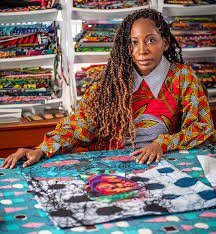
Bisa Butler is a fabric artist who describes her quilts as a photo album of Black families living in the diaspora. Learning to sew from her mother and grandmother, she chooses a vibrant palette of fabrics for the quilts. Bisa’s first pieces depicted people that she saw in her grandmother’s photo albums. Later, she used photos of Black families she found in the National Archives. Often the only information with the photo was the location, resulting in the erasure of any individual identity. Bisa wanted the anonymous people in the photos.

What can you do to learn more?
Read John Lewis In The Lead or Champion! by James Haskins
If you have 3 minutes, listen to Jasmine Mans read from Black Girl, Call Home.
If you have 5 minutes, watch Bisa Butler talk about her art and creative process. Bisa Butler: Portraits | Exhibition Stories
Dig Deeper
Black Children’s Books and Authors website
Faith Ringgold reads Tar Beach (Younger kids)
Art exhibit at Wa Na Wari, a Black-led space for Black people, Black art, and Black stories located in Seattle’s Central District, through April 14th.
Volunteer with Us!
There are many ways to be involved with our Sacajawea Parent Equity Team. A few of the ways to join us are below. Please contact equity@sacpta.org.
Join a monthly virtual meeting. Meetings are the first Wednesday of the month, 7-8:00pm.
Volunteer to write one of our bimonthly newsletters. It's a great way to learn and share, and you won't have to do it alone.
Event volunteer
With gratitude,
Sacajawea’s Parent Racial Equity Team
equity@sacpta.org
BLM at School: Audre Lorde and Toni Morrison - January/February #BlackLivesMatter
We are highlighting Audre Lorde and Toni Morrison in this newsletter. They share a February 18 birthday. Each author made significant contributions to literature and embodies the guiding principles of Black Lives Matter at School.

Dear Sacajawea Community,
Versión en español
Hello Sacajawea Community,
We are highlighting Audre Lorde and Toni Morrison in this newsletter. They share a February 18 birthday. Each author made significant contributions to literature and embodies the January and February guiding principles of Black Lives Matter at School: Queer Affirming and Unapologetically Black. Lorde and Morrison wrote about Black female experiences, facing opposition that sought to silence their voices. They remained true to themselves, despite the hostility they sometimes faced. Their legacies live on with the power of their words.
Audrey Lorde

Audre Lorde was a self-described "black, lesbian, feminist, socialist, mother, warrior, poet.” To be encompassing so many identities and face oppression on so many different levels, makes her strength and perseverance mind boggling at times. Her voice and her identity resonates strongly with the BLM at school principle of being Queer Affirming. Her words continue to ring true for many other oppressed people and remain relevant over twenty years after her death.
Toni Morrison

Toni Morrison used her voice to write honestly about the black experience, and even more specifically about the female black experience. She brought to life the people and places that had often been ignored throughout history. Her work is intense and beautiful and bold. Her work encompasses the BLM at School principle of Unapologetically Black through lifting up black lives. And the BLM at school principle of Black Women giving the space to be seen, heard, and valued. Toni Morrison became the first black woman to win the Nobel Peace prize for Literature.
What can you do to learn more?
Talk to your students about the info presented above. Ask them what they have been learning in class about the BLM Principals; use this website as a guide: BLM AT SCHOOL - Home (blacklivesmatteratschool.com)
If you have 3 minutes, read 5 Best Audre Lorde Books to Read Right Now
If you have 3 minutes, watch Toni Morrison - Writer & Playwright | Mini Bio
If you have 6 minutes, read Beyoncé and Lamar show what it means to be ‘unapologetically black’
If you have 6 minutes, watch At the intersection of LGBTQ pride and Black Lives Matter
Dig Deeper
Black Lives Matter at School: Unapologetically Black Book List
The 5 Best Toni Morrison Children's Books
I am Perfectly Designed (Younger kids)
Julian at the Wedding (Younger Kids)
12 KID-FRIENDLY LGBTQ COMICS (Older Kids)
Graphic Novels by Black Authors and Illustrators (Older Kids)
Volunteer with Us!
There are many ways to be involved with our Sacajawea Parent Equity Team. A few of the ways to join us are below. Please contact equity@sacpta.org.
Join a monthly virtual meeting. Meetings are the first Wednesday of the month, 7 - 8pm.
Volunteer to write one of our bimonthly newsletters. It's a great way to learn and share, and you won't have to do it alone.
Event volunteer
With gratitude,
Sacajawea’s Parent Racial Equity Team
equity@sacpta.org
Curious about who our school was named after?
The Sacajawea Cultural Center in Idaho will share with us about her life and legacy. There will be time for questions at the end; the whole family is welcome to join!
Join us for a live online presentation about Sacajawea!
The Sacajawea Cultural Center in Idaho will share with us about her life and legacy. There will be time for questions at the end; the whole family is welcome to join!
Thursday June 2, 5:30-6:30pm
Zoom Meeting
https://us05web.zoom.us/j/88517641136?pwd=RjNIVEdkcW1SdUJOcWd5ZHZtby9Kdz09
Meeting ID: 885 1764 1136
Passcode: bWry2G
Email equity@sacpta.org with questions
BLM at School Year of Purpose: Louise B. Miller and BASL
This month we are thinking about the ways many different identities can intersect in each of us.
Dear Sacajawea Community,
Versión en Español
Public harassment can leave you feeling helpless and afraid whether you are a witness or the target. The organization Right To Be (formerly Hollaback!) offers free interactive trainings to teach you how to intervene safely to stop harassment. Parent Equity Team is encouraging Sac families to save the date for the Bystander Intervention to Stop Xenophobic Harassment workshop hosted by Right to Be on April 20 at 5:00 p.m. Sign up here: https://zoom.us/webinar/register/WN_cTRjIlvKR7Wft3xD6S-6UA.
Our goal is to participate as a community to learn the skills needed to safely stop hate crimes and harassment. Parent Equity Team will also be hosting a Sacajawea-specific community debrief session, so we can review and discuss what we have learned together—keep an eye out for more details!
Louise B. Miller: A force for educational equity

This month we are thinking about the ways many different identities can intersect in each of us. We are celebrating both Women’s History and Deaf History Month, and highlighting an early pioneer of school desegregation, Louise B. Miller. In 1952, Ms. Miller, a Black mother, grew frustrated that she had to send her three deaf sons to a school far away from their home in Washington, D.C. She filed suit in federal court against the D.C. Board of Education to end the segregation that kept Black deaf children from being educated within the district.
On July 3, 1952, the U.S. District Court for the District of Columbia ruled in her favor in Miller v. Board of Education of District of Columbia, stating that Black students could not be sent outside a state or district to obtain the same education that white students could have within the state or district. Louise’s victory is considered a precursor to the 1954 Supreme Court decision in Brown v. Board of Education of Topeka.

Deaf schools were segregated throughout the country for decades, leading to the development of Black American Sign Language (BASL), a dialect of American Sign Language (ASL). Even though the legal segregation of Deaf schools has ended, about 50% of Black deaf Americans use BASL today. Nakia Smith, a Black deaf woman, has created videos that show some of the differences between BASL and ASL, including a preference for two-handed variants of signs. A video of Nakia and her grandfather signing together went viral, and she has continued to create videos that highlight BASL and its evolving history.
What can you do to learn more?
Talk to your students about the info presented above.
If you have 2 minutes, read Black Deaf Culture Through the Lens of History
If you have 3 minutes, watch How To Sign In BASL (Black American Sign Language)
If you have 5 minutes (or more!), read BIPOC Deaf Women in History
If you have 8 minutes, watch Celebrating and preserving Black American Sign Language
Dig Deeper
National Black Deaf Advocates
Louise B. Miller Memorial Project
#Deafwoke Podcast
Check out these books
Black Deaf Lives Matter: A fun coloring & activity book about Black Deaf life, history, culture & sign language, by Lissa D. Ramirez-Stapleton
My Deaf Friend Can Do Anything You Can Do, by Tanesha Ausby
Books to deepen your understanding of Black and Black Deaf experiences
With gratitude,
Sacajawea’s Parent Racial Equity Team
equity@sacpta.org