
Little Sac, Big World
Local & SPS News Affecting Sacajawea
New Choice Process Could Lead to Renewed Sac Closure Arguments
New SPS procedures governing the school choice process mean that Sac’s student enrollment could potentially drop next year.
New SPS procedures governing the school choice process mean that Sac’s student enrollment could potentially drop next year. Under enrollment was a main factor cited in last fall’s attempt to close Sac, though it was a false claim: Sac is fully enrolled, by SPS’s own standards [1]!
A drop in enrollment next fall could be weaponized by school board members who still want to close schools, reviving the specter of under enrollment—whether real or imagined—for use in targeting Sacajawea for closure once again.
In this article:
The Facts: What's Changing?
Sacajawea is a neighborhood school, where students are assigned based on where they live. Families can apply to send their student to attend a different school through the Open Enrollment for School Choice process.
SPS is changing two aspects of open enrollment next year: the timelines, and how they make choice assignments.
First, the open enrollment application deadline is moving one month earlier in the year, to Jan 31. This allows SPS to notify families of their choice decision by the end of February, before the commitment deadlines pass for most local private schools. This is a sensible and welcome change!
Second, SPS’s decision-making is also changing. The district plans to fill buildings more fully (up to 85% of operational capacity). They expect this decision to allow more students to receive their choice assignment compared with today.
More critically for Sacajawea, as Assistant Superintendent of Operations Marni Campbell explained at Wednesday’s board meeting, the district decision-making process will no longer protect enrollment at neighborhood schools.
Campbell said that there will certainly be schools that experience significant drops in enrollment as a result of this change. “We’ve already modeled it out,” she said, “and some schools are really going to feel this….We can anticipate which schools will be impacted based on historical choice patterns.”
Data indicates that Sacajawea is almost certainly one of the schools that will lose students under the new process. Historically, more than half of Sac-zoned students opt to attend other SPS schools (more details below). Campbell assured the board that impacted schools would not be allowed to “die on the vine,” but she didn’t explain how these schools would be supported.
Without a concrete support plan in place and having heard Campbell herself promote the false under-enrollment narrative in our own cafeteria during last year’s attempted closures, it’s not unreasonable to anticipate that enrollment drops caused by this policy could be used in the future as a justification to finally close Sac.
The Prediction: Why Sac Is Likely to See a Drop in Enrollment Next Year
Of the 58 elementary schools in SPS, Sacajawea has the second-highest percentage of families who leave via the choice program. Only Green Lake elementary loses more of its locally zoned students to other SPS buildings.
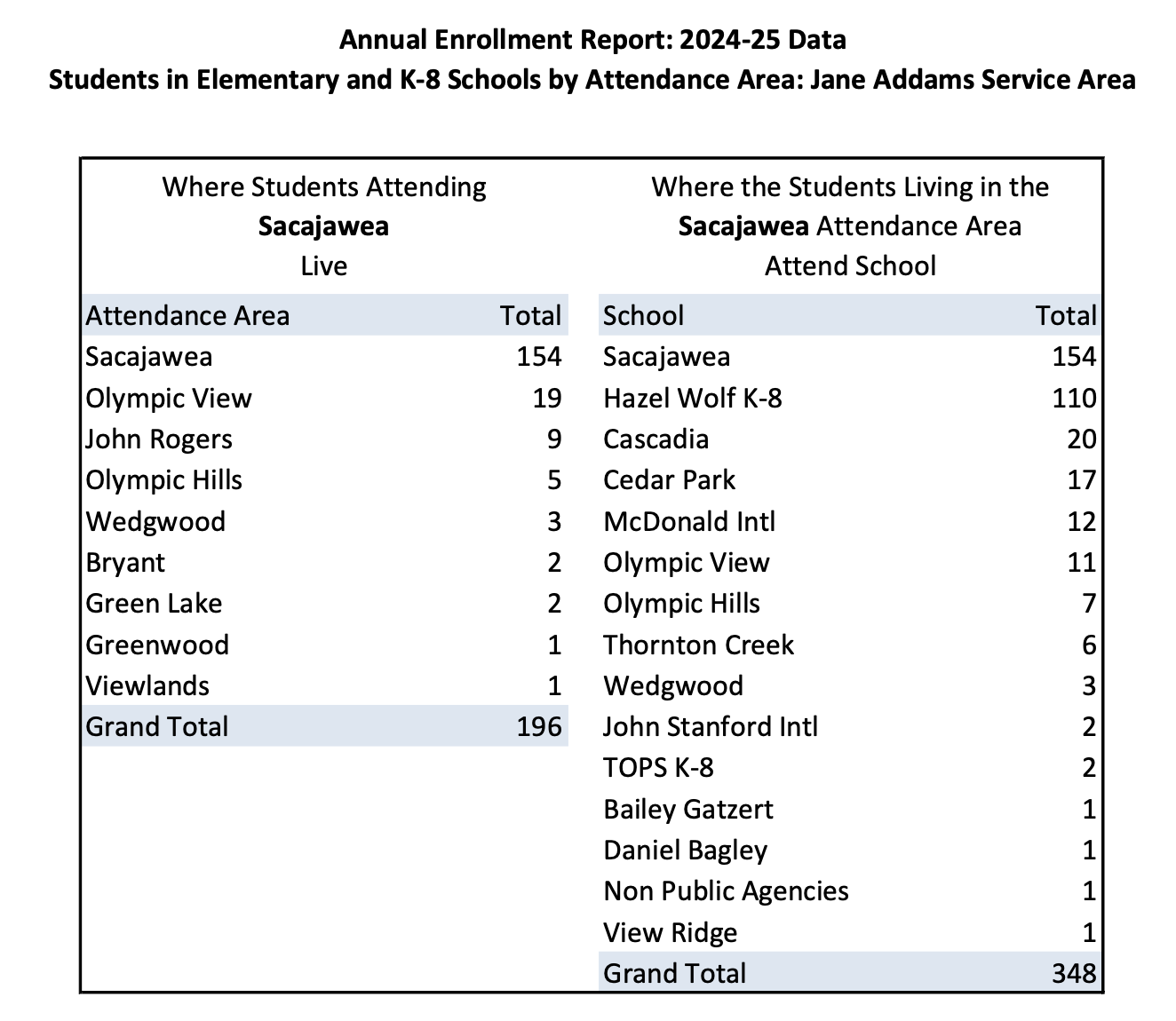
SPS 2024-25 enrollment report showing where SAc students come from, and where Sac-zoned students attend school.
According to SPS’s 2024-25 enrollment report, out of all of the SPS students zoned for Sacajawea, only 44% attended Sac. By comparison, district wide, 71% of students enroll in their attendance-area school.
Nearly a full third (32%) of students zoned for Sac instead attended Hazel Wolf elementary in 2024-25. Sacajawea-zoned students comprise 25% of Hazel Wolf’s K-5 student body!
We see that Sac’s attendance zone has a disproportionately large set of families who prefer to study elsewhere. This fact, combined with SPS increasing the number of students who are admitted to their choice school, and removing protections for neighborhood school enrollment, puts Sac at significant risk for increased flight.
Why Are Families Avoiding Sac?
If SPS has done an analysis on why families leave Sac at such high rates, I haven’t seen it. As a longtime Sac parent, I have my own thoughts that integrate comments and concerns I’ve heard from in our community. As I see it, there are at least four themes driving enrollment away from Sacajawea:
Sacajawea’s facilities are beyond dilapidated, and have been for over a decade. Major and minor repairs have been put off for years, in anticipation of a rebuild. In the 2023-24 school year, there were multiple roof leaks that persisted for months, requiring trash cans in the main corridor to catch the leaking water.
The 2016 opening of Hazel Wolf K-8, only one mile away from Sacajawea. Hazel Wolf is actually closer to home than Sac is, for many Sac-zoned students. Even John Rogers Elementary, into which SPS tried to consolidate the Sacajawea population in 2024, is farther away from Sac (1.23 miles) than Hazel Wolf is. John Rogers is also farther from the homes where Sac-zoned families live (see the SPS zoning map, copied below). It’s no wonder that families have so often chosen shiny new Hazel Wolf, so close to home!
The BEX V levy passed by voters in 2019, which signalled a commitment to a potentially disruptive Sacajawea rebuild. This levy set aside finances for the design of a Sacajawea rebuild. From this time on, the community has consistently anticipated a near-future two-year closure period for a rebuild. Anecdotally, some families have chosen to avoid such a disruption by moving their kids to a place where they could spend their remaining elementary years in a single, stable environment.
The 2024 targeting of Sac for closure created ongoing community concern about the possibility of ongoing closure threats. Questions and anxieties about upcoming closure are regular on the school community’s Facebook page (private), especially from parents of rising kindergarteners. As a parent member of Sac’s BLT team, I am asked semi-regularly on the playground for updates about whether we’re getting rebuilt or closed. Nobody knows what’s happening, and the uncertainty is destabilizing.
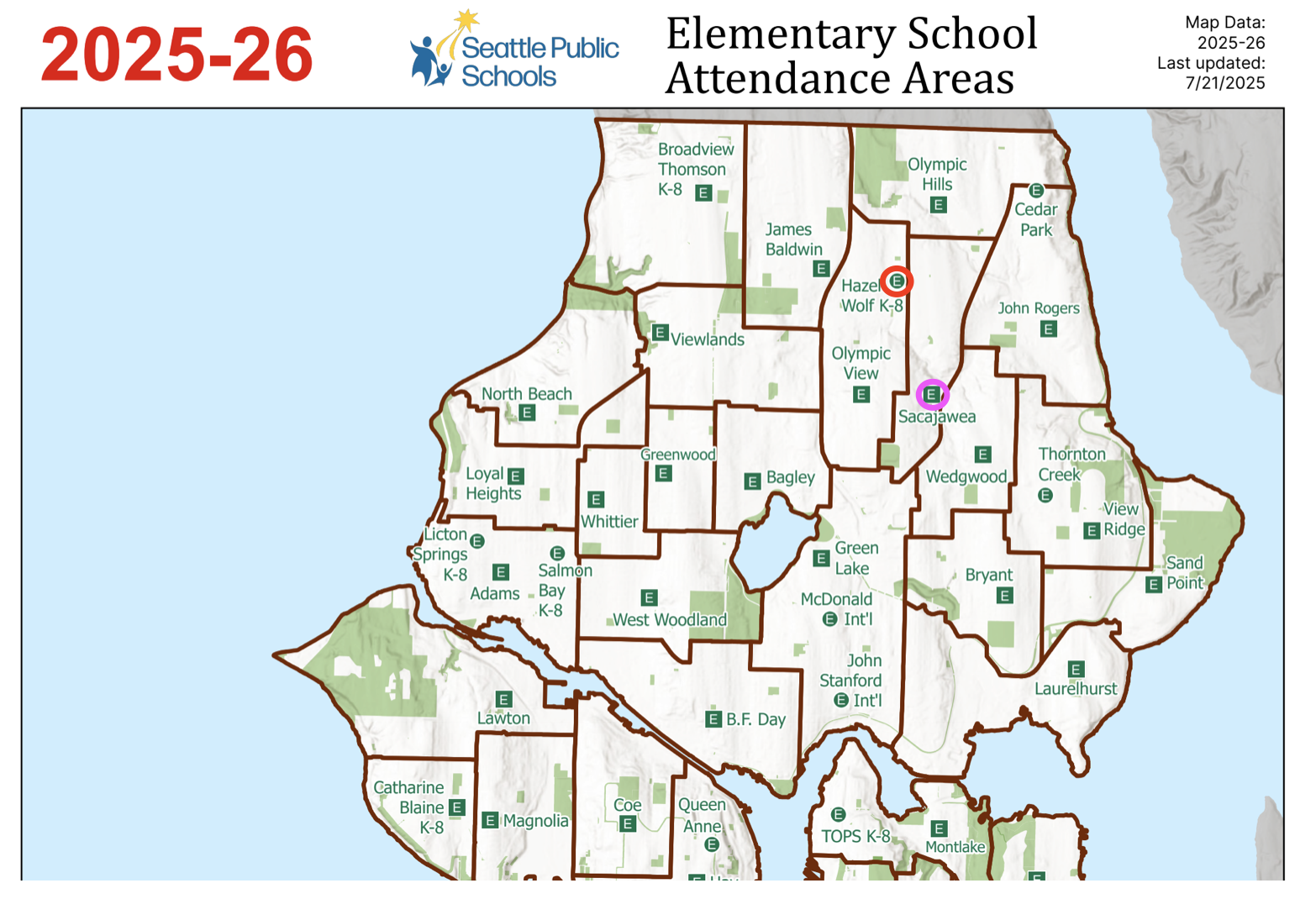
SPS attendance area map for 2025-26 (circle annotations mine). note how most of the area of sacajawea’s attendance zone is actually closer to hazel wolf k-8.
The Risk: A Sac Enrollment Drop Could Be Used to Reinvigorate Closure Arguments
I am concerned that a drop in enrollment will lead to renewed calls for Sacajawea’s closure. I am concerned because:
Although closures are temporarily off the table during this time of leadership transition, the board has not eliminated the possibility of near- or mid-term closure plans. Some board members even continue to push for closures.
Last year’s attempted closure was pushed forward via a (false) narrative of under enrollment. Both Assistant Superintendent of Operations Marni Campbell and Director of Enrollment Planning Faauu Manu cited this heavily in the meeting at our school, despite their own data at the time showing that it was not true—in fact, Sacajawea operates at 90% of our building’s estimated capacity [1]. With the district having so eagerly pushed for closure based on a false under-enrollment narrative, I worry that a year with a real enrollment dip will be seized upon as justification for renewed closure attempts.
The conditions that lead to families opting out of Sac are not inevitable. These conditions have been created by district policies. These policies and conditions can be changed.
Leaving our school to crumble into disrepair, unmaintained over 70 years, and then calling it unfit to house students is a policy choice. This is not a natural disaster that could not be foreseen. It’s a man-made disaster that the district has allowed to happen.
Building two new schools—Hazel Wolf and John Rogers—in close proximity to Sac without any planning for how to accommodate the downstream effects of those constructions is, again, a policy choice. The district might have included forward-looking rezoning plans that update school boundaries and factor new constructions into account. It might have engaged with school communities to develop multi-year consolidation plans that support community needs and relationships through a shift. It did none of these things, and that is why Sac is in the state of undesirability that it is today. It didn’t have to be this way.
What Does This Mean for Sac?
If somehow it’s not clear by now, I fear that the new changes to the school choice process will cause a dip in Sac enrollment that reinvigorates a push for Sac’s closure. I hope I’m wrong.
If we face a renewed closure fight in the coming years, I want our community to understand that the decline of Sac—both its physical structures and its relative desirability—has been a calculated, policy-driven phenomenon. A crumbling school with an uncertain future was not inevitable!
Here’s the good news: Outcomes that are not inevitable can be changed. When I see opportunities for us to influence Sac’s future, I’ll share them here. This might look like public testimony at a board meeting, or meeting with district staff. For the moment, it might simply look like educating others in the Sac community about how to address pressures and risks that Sac faces.
On the topic of enrollment specifically, the next interesting moment will come in late February. This is when the district publishes its enrollment projections for the following year, in the “Purple Book” (here is last year’s).
February’s 2026-27 enrollment projections will tell us what impact the district thinks the new choice policies will have on Sac’s enrollment.
From there, we’ll get a better sense of the scope of a potential problem. Maybe that problem takes the form of closure arguments down the line. Maybe that problem simply looks like staffing numbers so small that even our split-classroom staffing solutions no longer work. Maybe I’ll be wrong—maybe Hazel Wolf’s K-5 classrooms are already full, and I will get to delightedly report back here that Sac enrollment is unchanged.
Stick with me through February and we’ll find out together!
[1] Sacajawea is not under enrolled! According to SPS’s 2021 Facilities Master Plan Update (the latest available), Sacajawea is operating at 80% of our operational capacity, and at 90% of our right-sized capacity. Operational capacity is used for short-term planning, and it includes portables in its assessment of usable space. Right-sized capacity is used for long-term planning and does not include portables. The SPS policy goal guiding open enrollment assignments this year states that schools should operate at 85% of their operational capacity.
Sac’s student population has remained largely stable since 2021: we had 198 students then, and we have 199 as of December 1 of this year.
Literacy & Math Benchmarks at Sac
In this post, we cover the performance of Sac students at literacy & math goals set by the school board.
This week, we cover the performance of Sac students at literacy & math goals set by the school board.
District-Wide Benchmarks
The school board set district-wide math & literacy goals back in January, intended as key anchors to guide all board decisions. At last week’s special board meeting, interim superintendent Fred Podesta walked through a progress monitoring report describing how we’re doing, and what comes next.
So, how is Sac doing?
Literacy Goal
Here’s the board’s literacy goal, adopted in January:
The percentage of 2nd grade students who meet or exceed grade-level standards for early literacy skills based on the MAP assessment will increase from 57.7% in Spring 2025 to 67.7% by Spring 2030.
School-specific MAP scores are not available to the public, but Smarter Balance Assessment (SBA) test statistics are public and strongly correlated with MAP results. By the SBA measure, Sac is 4 points behind the district average. According to OSPI, 58.6% of last spring’s Sacajawea third-graders were grade-level proficient or better in ELA on the SBA. District-wide, that percent was 62.6%.
The population served by Sac is potentially relevant here: 33%-40% of Sac students have IEPs annually, compared to 13% of students district-wide, while 37.7% of Sacajawea students have a disability, compared with 18.2% district-wide.
District-wide performance on the literacy goal is shown in the chart below. The chart also highlights performance of subpopulations tracked by the district; the literacy benchmark performance shows that these groups face significant opportunity gaps.
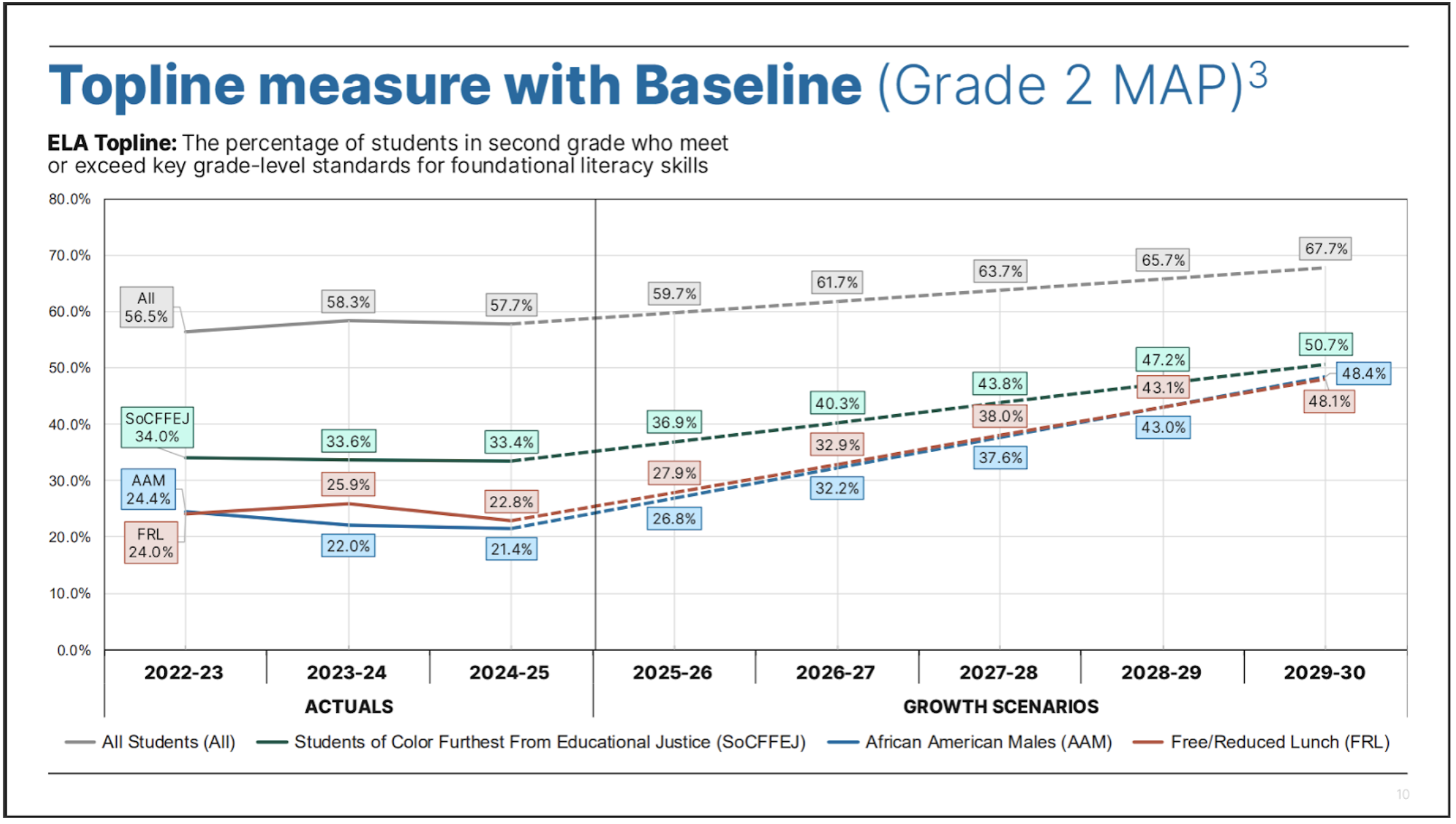
SPS slide benchmarking district performance on the board’s literacy goal (second grade reading evaluated on the map test)
Math Goal
Here’s the board’s math goal, also adopted in January:
The percentage of sixth graders prepared to succeed in math coursework in seventh grade, as measured by the sixth-grade Smarter Balanced Assessment (SBA), will increase from 56.8% in June 2025 to 66.8% in June 2030.
Obviously, we have no sixth-graders at Sac. We can look at JAMS, though, since that’s where the majority of Sac students attend middle school. Last spring (2025), 54.8% of JAMS sixth-graders were grade-level-proficient on the math SBA test, compared to 56.8% district-wide.
How do these goals affect Sac?
Last week’s strategic plan presentation was light on detail about how these goals will be achieved, but I’ll report back here if more details emerge in future board meetings.
That said, many of the so-called “emerging initiatives” focus on increased professional development for teachers, and on multi-tiered support structures (MTSS) to assist students with varying abilities. It’s likely that we’ll see versions of these introduced at Sac in coming year or two.
If you notice new things being tried in your child’s classroom, please let me know! I enjoy connecting our classroom activities to board- and district-level policies.
Read more about the board’s progress monitoring meeting here, or watch the full board meeting video with transcript here.
Fun fact: Most statistics in this post are from OSPI’s report card, where you can interact with district- and school-level information about enrollment, demographics, test scores, and more!
Introducing: Little Sac, Big World!
District staff proposed a new student cell phone policy at last week’s board meeting. The three-tiered policy is likely to change before rollout in the 2026-27 school year, including a total ban on student cell phones in elementary schools.
Welcome to Little Sac, Big World! Here, you’ll find bite-sized summaries of recent events directly affecting Sacajawea’s future. Posts will be concise, and written in terms of how the news directly affects Sac. From state legislative changes, to SPS board decisions, to new district policies, to city mandates, my plan is to connect goings-on in the wider world to our Sacajawea community here at home.
I am Julie Letchner, this year’s Advocacy Chair. You can reach me at advocacy@sacpta.org with questions or with topics you’d like to see covered here. I hope you join me!
This week’s news: New student cell phone policy coming in 2026-27
District leaders have proposed a three-tiered cell phone policy for rollout district-wide in 2026-27. The policy as proposed is likely to change before rollout, based on community and board input. The proposal includes a total student phone ban for elementary schools, and increasingly permissive policies for students at the middle and high school levels.
Read on for additional details.
SPS Floats New District-Wide Cell Phone Policy for 2026-27
SPS is developing a district-wide student cell phone policy, to be rolled out in the 2026-27 school year. At the Nov. 19 board meeting, staff proposed a three-tiered policy:

A slide from sps staff’s presentation to the board, outlining a three-tiered cell phone policy proposal.
Staff elaborated that the proposed Elementary policy means no student phones on-site at any time—not even if stored in lockers or bags. The Middle School policy allows phones on site, but requires that they be stored backpacks or lockers from first to last bell.
This proposal is likely to undergo revisions before becoming district policy. Public engagement on the topic is planned, though staff did not share an engagement plan or timeline. Board member comments also surfaced ideas that may end up factoring into an updated policy proposal, including:
A shared preference for the high school policy to shift closer to the middle school Away for the Day, to keep enforcement straightforward and to remove the burden of enforcement off of individual teachers.
A desire for clear policy exceptions for students requiring personal devices for accessibility (e.g. language translation) or medical use (e.g. glucose monitoring).
A concern that the elementary policy is untenable, in particular for children who coordinate after-school transportation using personal phones.
A desire for district-wide guidance stating what should happen when the cell phone policy is violated.
For more information, see the Seattle Times Article about the proposed cell phone policy, or the full presentation video (including a written transcript). To jump straight to the board’s discussion of the proposal after the presentation, go here.
How This Affects Sac
Sacajawea, like all other SPS schools, will be required to adhere to any new district cell phone policy. SPS is planning community engagement later this school year. I will post again here if & when input opportunities are announced.
In the meantime, the general public—that’s us!—is always welcome to sign up to give public testimony at school board meetings. The sign up link and policies can be found here.