
Literacy & Math Benchmarks at Sac
This week, we cover the performance of Sac students at literacy & math goals set by the school board.
District-Wide Benchmarks
The school board set district-wide math & literacy goals back in January, intended as key anchors to guide all board decisions. At last week’s special board meeting, interim superintendent Fred Podesta walked through a progress monitoring report describing how we’re doing, and what comes next.
So, how is Sac doing?
Literacy Goal
Here’s the board’s literacy goal, adopted in January:
The percentage of 2nd grade students who meet or exceed grade-level standards for early literacy skills based on the MAP assessment will increase from 57.7% in Spring 2025 to 67.7% by Spring 2030.
School-specific MAP scores are not available to the public, but Smarter Balance Assessment (SBA) test statistics are public and strongly correlated with MAP results. By the SBA measure, Sac is 4 points behind the district average. According to OSPI, 58.6% of last spring’s Sacajawea third-graders were grade-level proficient or better in ELA on the SBA. District-wide, that percent was 62.6%.
The population served by Sac is potentially relevant here: 33%-40% of Sac students have IEPs annually, compared to 13% of students district-wide, while 37.7% of Sacajawea students have a disability, compared with 18.2% district-wide.
District-wide performance on the literacy goal is shown in the chart below. The chart also highlights performance of subpopulations tracked by the district; the literacy benchmark performance shows that these groups face significant opportunity gaps.
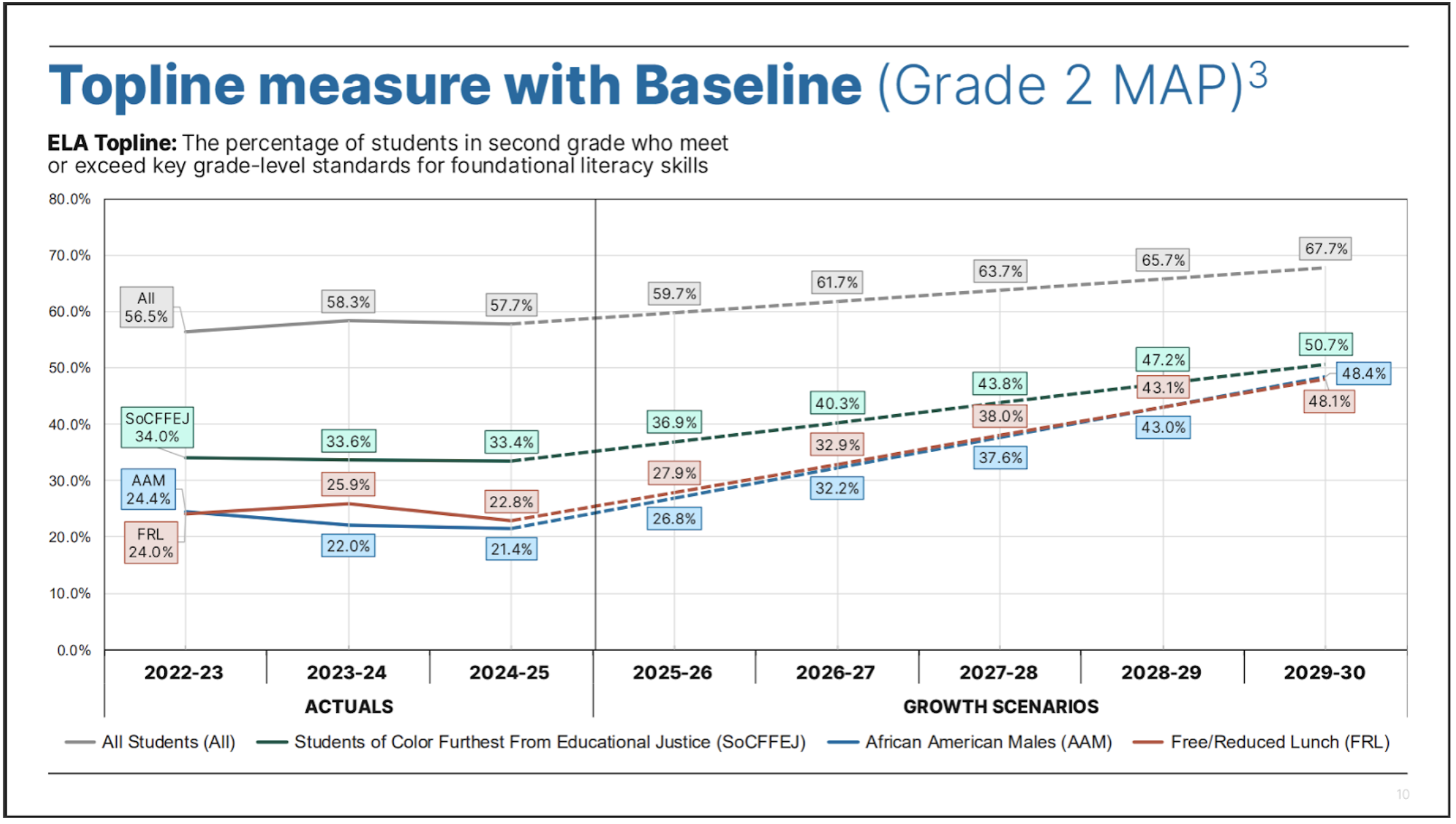
SPS slide benchmarking district performance on the board’s literacy goal (second grade reading evaluated on the map test)
Math Goal
Here’s the board’s math goal, also adopted in January:
The percentage of sixth graders prepared to succeed in math coursework in seventh grade, as measured by the sixth-grade Smarter Balanced Assessment (SBA), will increase from 56.8% in June 2025 to 66.8% in June 2030.
Obviously, we have no sixth-graders at Sac. We can look at JAMS, though, since that’s where the majority of Sac students attend middle school. Last spring (2025), 54.8% of JAMS sixth-graders were grade-level-proficient on the math SBA test, compared to 56.8% district-wide.
How do these goals affect Sac?
Last week’s strategic plan presentation was light on detail about how these goals will be achieved, but I’ll report back here if more details emerge in future board meetings.
That said, many of the so-called “emerging initiatives” focus on increased professional development for teachers, and on multi-tiered support structures (MTSS) to assist students with varying abilities. It’s likely that we’ll see versions of these introduced at Sac in coming year or two.
If you notice new things being tried in your child’s classroom, please let me know! I enjoy connecting our classroom activities to board- and district-level policies.
Read more about the board’s progress monitoring meeting here, or watch the full board meeting video with transcript here.
Fun fact: Most statistics in this post are from OSPI’s report card, where you can interact with district- and school-level information about enrollment, demographics, test scores, and more!