
Little Sac, Big World
Local & SPS News Affecting Sacajawea
Strike Support 101
Ways to support the Sac community’s families and teachers in the (likely) event of a strike next week.
Hello, Sac! You’ve probably heard by now that there is a real risk of a teacher strike starting on Wednesday. I thought I’d take a moment to walk through some of the logistics of what that could mean for Sac families and staff.
Although the teachers union (formally the Seattle Education Association, or SEA for short) voted on Wednesday to authorize a strike, that doesn’t mean that a strike is a certainty. If SEA and the district can come to an agreement by Tuesday then school will start as planned on Wednesday, Sept 2.
If not, well…we’re looking at a strike. If you agree with rumors—and in this case, I personally do—a strike is likely. In that case, both our Sac staff and our fellow Sac families will need support. Here’s how we can all help each other out.
But first, a fun fact: SEA doesn’t just represent teachers! They represent a majority of SPS staff–about 6,000 of SPS’s roughly 7,500 employees. The union includes certificated teachers & substitutes, paraprofessionals like instructional assistants, office staff, and family support workers, and a bunch of lesser-known roles like the craftspeople who do musical instrument repair for the district! SEA does not include principals and custodial staff, who are represented by their own separate unions.
Ok. Back to the main idea:
How you can support Sac staff during a strike
In the event of a strike, staff will be picketing on the sidewalk outside of Sac. This has a few implications for folks who’d like to support the strikers:
Staff need water/food/restroom support. The building will be locked with no access for staff. Seth and I live very close to the school and we will open up our house and yard as a rest/refresh station, as we did in 2022. Community dropoffs of bottled water, coffee, snacks, and so on are extremely helpful in making this successful.
In 2022, support donations were strong for the first several days and then tapered significantly. So if you can’t help out immediately, please don’t hesitate to jump in a few days later (if it comes to that)!
Staff could use moral support. Sac is on a quiet street with minimal traffic. Picketing without an audience can get tedious quickly. We can all help by stopping by and joining the picket line, even if it’s just for an hour. Wear red in solidarity for extra credit.
Take this opportunity to talk with staff about what’s at stake in the negotiations, or just get to know them a little more! You’re encouraged to bring your kids, too (but please do not leave them unsupervised).
If anyone wants to get extra creative, consider dropping off fun supplies like sidewalk chalk, bubbles, or a set of homemade picket line Bingo cards. Use your imagination. Anything that adds some joy to a day of marching in the sun will be welcome!
Some staff will need childcare. Teachers who are also parents to SPS students will need childcare in order to join the picket line. Many of our Sac students will need care as well. Read on.
How you can support families during a strike
The obvious primary need families will have is childcare, particularly for families for whom care is necessary to allow parents to work.
If you’d like to help me organize a childcare pool, please let me know! I’m not sure yet what this might look like. Maybe it’s a signup page where folks offer and accept half-day or full-day slots of watching a handful of kids? Maybe it’s some kind of swap situation where folks trade days? Maybe we can gather together a handful of parents who can watch a group of kids in the park for a day (again, Seth’s and my restrooms are available to support this)? I’m open to ideas.
At any rate, if you or a family you know will have childcare needs because of a strike, please reach out to me and I’ll see if I can connect you with someone from the community who can help. Same goes for folks who have the ability to watch an extra kid for a bit.
I believe that there will be a small handful of Boys and Girls Clubs open in the event of a strike, but that Sac’s won’t be one of them. Families enrolled at Club for this coming school year should have already received an email about this.
***
A final note: Everyone will probably have a keen, ongoing desire for information in the event of a strike.
The picketing teachers are by far the best source of union information. The district generally stays quiet about their side of negotiations, but they will tell us when school is postponed and/or when the first day of school will be. I will be keeping myself up to date as well, and I’m happy to answer any questions as best I can (advocacy@sacpta.org, or feel free to text me if you have my number).
I will not, however, be writing about the progress or content of negotiations here.
The PTA must remain officially neutral on bargaining issues, so you won’t be hearing any opinions about the actual negotiations on this blog. The PTA’s role here is to support families and staff disrupted by a strike and to encourage both sides to come to an agreement that is in the best interest of students & staff.
See you on Wednesday, either at the dropoff line or the picket line!
Mapping Our Community Power & Leverage
What are the sources of our community power? What is our leverage in a closure situation? We have more of both than you might think!
This is part four of a four-part series preparing for a possible Sac closure announcement. Find the rest of the series linked here.
If a Sac closure is announced this year, we’ll certainly have advocacy work on our hands. Maybe the work will be a campaign to stay open, or maybe it’ll be a struggle to shape the terms of closure in a way that makes sense for our community. Maybe it will have to be both simultaneously.
In the absence of a closure announcement, we will have to advocate for adequate resourcing: music education, class sizes that meet district standards, and, if we’re feeling very powerful, perhaps some basic facilities maintenance!
In any case, advocating successfully requires power and leverage. Where is the Sac community’s power? What is our leverage, especially in a closure situation?
The source of our power is us. It’s cheesy, sure, but it’s true. If we hadn’t fought against the 2024 closure attempt, Sac would be closed today. It was the exercise of our power that changed that outcome.
We get our power from our numbers, our skills, and our relationships. An entire community can’t be ignored the way a single individual can. Our collective skills amplify our power, and between us we have many skills: communication, data analysis, storytelling, hope kindling, sign making, rally organizing, relationship building, and neighborhood canvassing. That doesn’t even include the skills we have to deploy in support the people doing this work—with childcare, food, and the moral support of a listening ear.
Relationships matter here, too. We have relationships now with families across the city who opposed the 2024 closures. We are organized, in the very concrete sense that involves email lists and Slack groups and community meetings and experience working together and shared trust. That is power.
We have a lot of power. The question will be how we use it.
***
Without any official authority, public pressure is our primary tool.
The purpose of public pressure is not to beg for a different outcome and hope that the people in charge change their minds because our stories are so compelling. No.
The purpose of public pressure is to change conditions so that those with authority find it easier to deliver our desired outcome than to stick with their original plan.
Successful public pressure campaigns are not exercises in begging. They are exercises of power.
Successful advocacy against closures, then, looks like building enough public resistance to closures that they are no longer worthwhile to district leadership. I use “building” intentionally here: doing this requires serious organizing.
The scales of power tip when the superintendent and board start worrying about losing their jobs or elections, or worrying that they’ve lost sufficient public trust to do their work effectively, or worrying that the dominant public narrative is personally uncomfortable or damaging.
The tipping point is situational. In 2024, with an already weak superintendent poorly supported by the board, it was easier to tip the scales than I think it would be this fall. But that doesn’t mean it’s impossible.
***
So, what leverage do we have to create a successful public pressure campaign opposing closures?
We have more than you’d think, largely because of the public discussions surrounding the 2024 attempted closures.
Superintendent Shuldiner, for example, is on the record stating that any future closures will be done with better community engagement than before. From KUOW in May:
In [Superintendent Shuldiner’s] view, the district made two critical mistakes back then. Top of the list: The dreaded “closure list.”
Shuldiner said that list appeared to be made “by fiat,” in a process that didn’t include the community, and he apologized the district was not “open, transparent, or even collaborative around these things.”
“We have to be really thoughtful about how we’re making decisions with the community,” he said, “not without the community.”
Those statements create leverage¹.
If a 2026 closure process begins with a list made “by fiat”, our organizing task becomes one of highlighting the loss of public trust—the cost to Shuldiner—that such a reversal incurs. Why should the city trust a leader who says one thing and does the opposite?
Shuldiner has led from the beginning with core themes of transparency and engagement. This has been good for the district and is appreciated by many, including me. I hope—and I actually do anticipate—that this style of leadership continues. If it doesn’t, though, a retreat from his stated principles does make Shuldiner vulnerable.
***
Several members of the board are also on the record regarding school closures. Their statements present opportunities to build pressure in a future closure situation.
Director Smith’s 2025 campaign website, for example, says of closures:
To better engage the community, SPS must amend its Closure Policy, SPS 6883. Right now, the policy begins with the Superintendent’s recommendation and analysis, treating public engagement as an afterthought. That must change. Engagement with communities should be the first step, not a formality after decisions are made.
Has Smith taken any steps to change policy 6883 since she joined the board eight months ago? Has there been any public engagement related to upcoming closures? If not, that’s an opportunity to apply pressure, especially because it is clear that the board is now actively involved in discussions about closures mergers.
Smith is filling a temporary board vacancy and will have to rerun for her seat in 2027 if she wants to continue on the board.
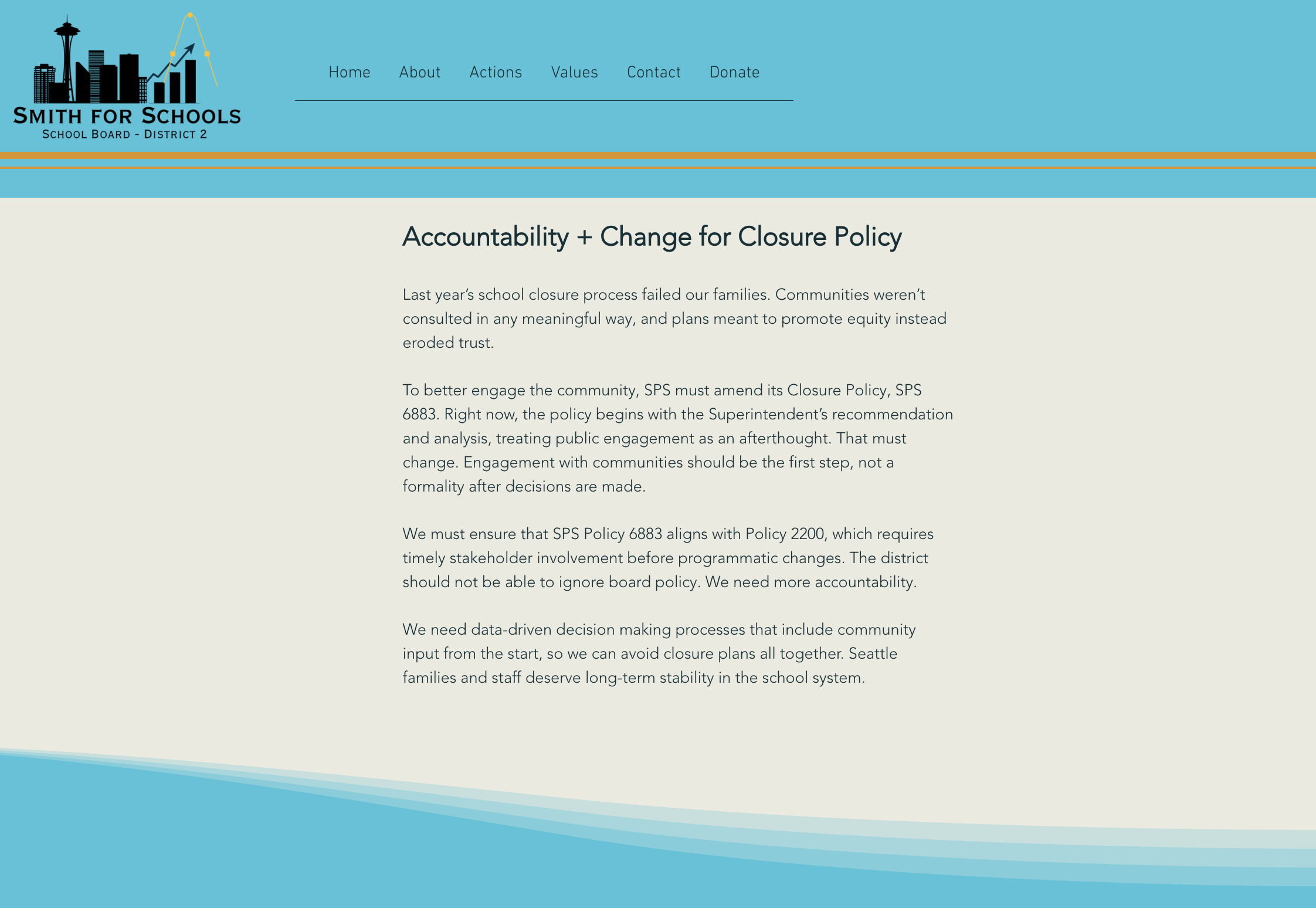
A screenshot of Director Smith’s campaign website from 2025, in which she outlines her position on school closures. The site, smithforschools.org, has since been taken down.
Director LaVallee’s campaign website reads, on closures, “Any closures should only be considered through meaningful partnership with affected communities, prioritizing student needs over financial calculations.” We can hold her to that.
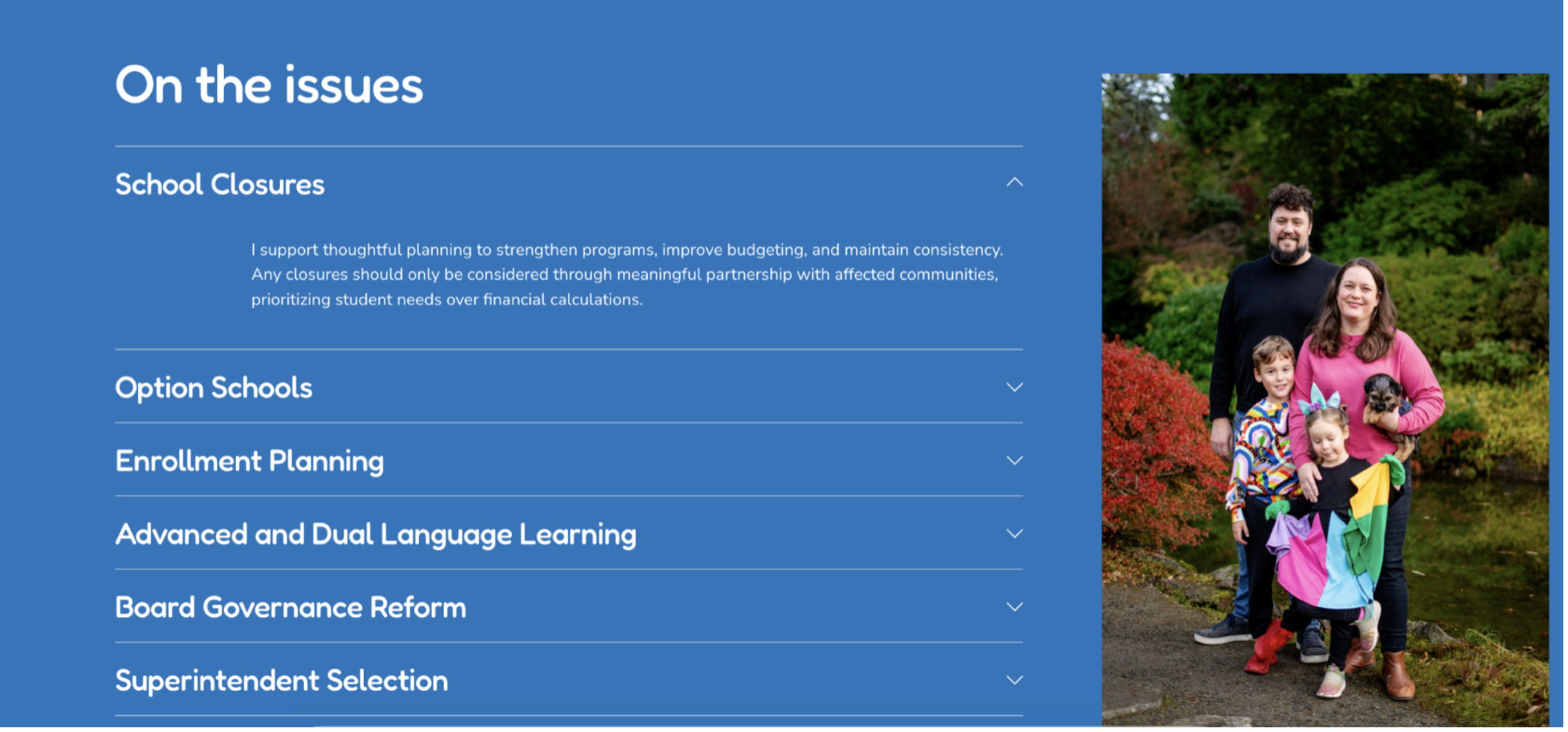
A screenshot of Director LaVallee’s campaign website from the 2025 election, in which she outlines her position on school closures.
Finally, who can forget the tearful, ten-minute speech given by then-President Rankin about how frustrated she was by the 2024 closure plans (after she advocated² for those same plans months earlier)? Rankin continues to believe that closures are necessary—she even ended that very speech with the phrase, “I’m not saying we don’t need to consider consolidations still...”
However. When it comes to Sacajawea specifically, here’s what she said that night:
What if we kept that [special education] model that they [Sacajawea] have that's so incredible and what if we use it as an asset to train more educators in inclusionary practices?
What if we built that school? What if we rebuilt that school at 300 or 350 so that educators could go there for two years and then take those best practices out into other buildings?
What if, indeed? If Sac comes under closure pressure again, Rankin needs to back up her words with action—or face the loss of trust that comes from not doing so.
***
Thanks for joining me over these past weeks in thinking about what Sac’s future might look like and how we want to shape it!
I will be organizing a casual community meeting soon, where we can talk about all of this over snacks. Everyone will be welcome.
Yes, you! Please join us! It doesn’t matter if you’re new to Sac or have been around for years. It doesn’t matter whether you were involved in the 2024 closure pushback or not. If you want Sac to stay open, please join us. If you think Sac is better off closed, please join us. If you don’t care either way (yet), you should still join us! The purpose of this meeting is to get a feel for where the community’s mind is on all of these interrelated issues, and to educate one another.
There will be no agenda, per se, but here are the core questions I expect to come up naturally at this gathering. Bring your own, too!
What does the majority of Sac’s population want for Sac’s long-term, stable future? A closure? A rebuild? Something else?
If a Sac closure is announced in 2026, what themes would we like our community response to include?
If Sac is closed, what do we want to see happen to the Sac building and property? What outcomes do we especially want to avoid?
What skills can each of us contribute to getting the outcomes we’d like? What are people’s energy levels like right now, about these issues?
If closures are announced in 2026 and, for some reason, they don’t include Sac, what would we like our community response to be? What does solidarity look like in this case?
I hope to see you soon!
If you missed any of the previous entries in this series, you can jump to them from the intro or using these links:
Mapping our community power and leverage (you are here)
FOOTNOTES
¹The statements are also good leadership. I’m preparing us for a hypothetical fight in this series, and I’m ready to have it. But I’m also holding space for the district’s new leadership to surprise us. Maybe hypothetical fall closures really would be considered with community involvement, and then introduced in a way that meaningfully engages families and is transparent and well-reasoned. Maybe closures aren’t imminent. One never knows!
²The original article was removed from KUOW’s online archives at some point in July 2026. I can’t say or speculate as to why.
Things to Consider if Sac Must Close
If Sac is shut down, I want our families to get a future better than the one we’re losing. I want the building to be maintained and useful. And I want to help other neighborhood schools avoid this fate.
This is part three of a four-part series preparing for a possible Sac closure announcement. Find the rest of the series linked here.
I don’t want to tempt fate by writing about closure as if it’s a foregone conclusion. And to repeat myself once again, closure has not been proposed at this time.
If Sac does wind up closed, though, the questions about what happens afterward need to be resolved while the closure is still being discussed. The better prepared we are going into that conversation, the more likely we are to secure outcomes that benefit our community.
Preparing for a positive closure outcome doesn’t mean we’re giving up on Sac. It means we’re preparing for all eventualities.
Here are three things I want to fight for if Sac must close:
1. I want families to get a better future than the one we’re losing.
Maybe that translates to priority enrollment at any other SPS school, including dual language, etc. Maybe a better future includes guaranteed bus transportation for some number of years, too. Maybe it looks like allowing families to select into buddy groups who will be guaranteed enrollment in the same school together through the end of their families’ elementary years.
Maybe a better future includes distributing Sacajawea’s teaching staff as directly as possible to the site(s) that are gaining the most former Sac students.
It’s likely that a better future involves active planning and engagement—supported with a budget—to integrate Sac students into their new communities, especially in places where large cohorts of Sac students land.
Choice priority will be especially important for Sac’s special ed students. We have a disproportionate number of special ed kids here precisely because this population is already so frequently excluded from their neighborhood schools. Sac is the place they’ve ended up because Sac has the supports they need. Many of these students also have a more-difficult-than-average time adapting to change. Let’s find them alternate educational homes that they can rely on for the long term, without further disruptions.
The ingredients for a better future will differ for different families. This is a community discussion we need to have, and we can start having it before any closure is even announced. We need to figure out as a community what we most want to advocate for.
2. I want a plan for the empty building that respects the neighborhood.
By far the most common outcome for closed schools nationwide is that they sit abandoned and fall into disrepair from lack of maintenance and vandalism. Here’s a spoiler from a beautiful, visual article that chronicles the outcomes for the 46 buildings that Chicago public schools closed in 2013: Over half of the buildings still sit abandoned.
Nobody wants this for Sac.
The time to apply pressure for a better building use is during, and even before, the closure discussions. Afterward is too late.
At the very minimum, I want the playgrounds to be publicly accessible and maintained. This should be a given, but even with Sac in operation, we’ve had to apply pressure to keep the outdoor spaces unlocked in the evenings and on weekends. We cannot let a school closure add insult to injury by permanently closing off or privatizing existing public play spaces.
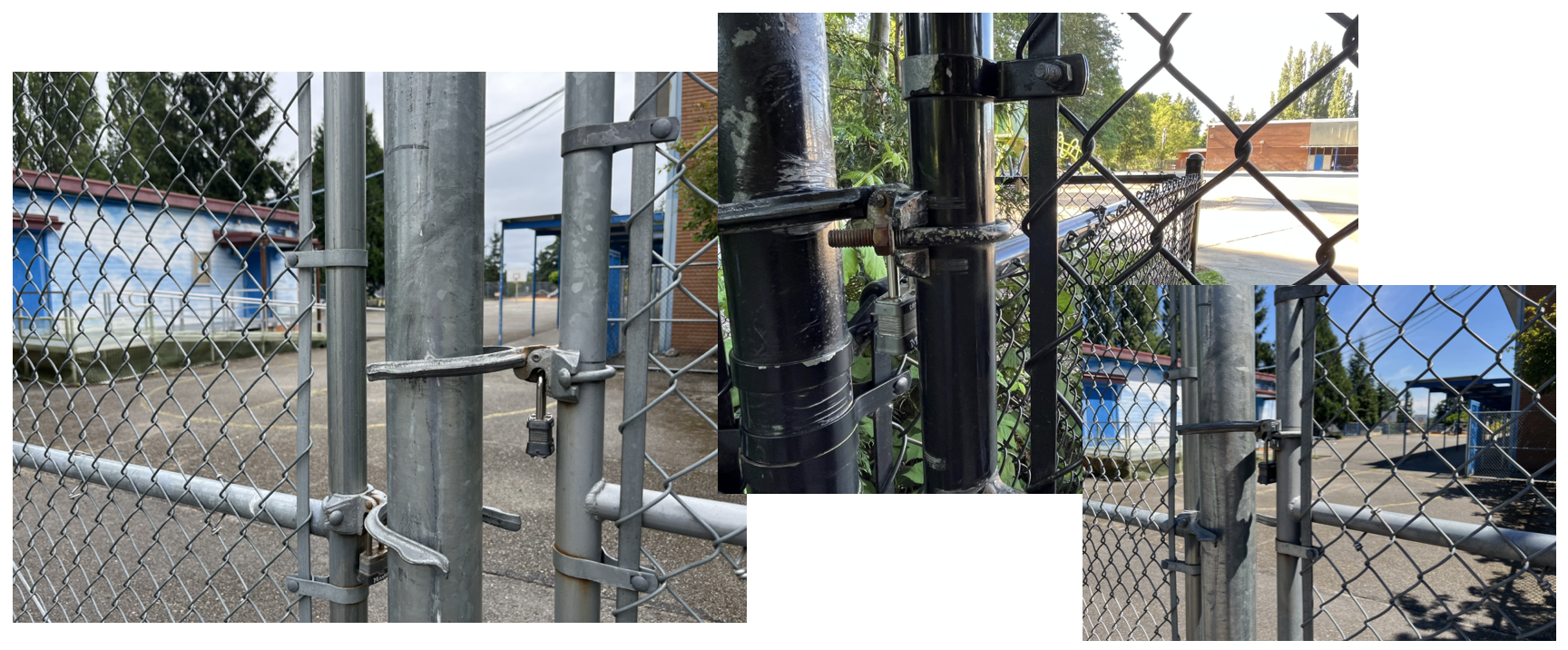
Photos of the Sacajawea playgrounds locked against public access. Photos were taken on weekends and evenings in June 2026, when neither the school nor the on-site Boys & Girls club were in operation. This is not a long-term future I want for our neighborhood.
Even better, I’d like to see the building itself be useful. There are a few ways that this might happen, but none of them seem likely¹. Any tenant who might want to buy or lease the space is likely to require renovations, which are costly—or, if they aren’t, maybe someone can explain to us why Sac hasn’t seen any in 75 years. Demolition is expensive and forecloses the possibility of a future remodel and reopening by SPS.
Importantly, any guarantees that SPS makes about maintenance, demolition, renovations, rental to community groups, or anything else must be reconciled with the arguments they are making about closures saving money. The logic has to be consistent for the public (that’s us!) to believe that any promises will be kept.
Bonus read: I found this short article to be extremely valuable in shaping my thinking about what can happen to the property when a school building closes.
3. I want a commitment to boundary updates and long-term facilities planning.
Sacajawea is in this situation because the district failed, for decades, to support the basic maintenance needs of our building. The construction of a brand-new Hazel Wolf one mile away, without any boundary adjustments, began draining Sac’s population. The 2024 closure threat and the cancellation of our planned rebuild are just the latest blows in a long series of decisions made without foresight.
SPS’s elementary building utilization is low (65% in 2024) because the district keeps building elementary schools with a capacity of 500-650 kids in an environment of declining enrollment—and, again, without adjusting attendance zone boundaries to compensate for the huge increases in capacity.
Whose job is it to change these patterns? It’s the board’s job, and I want them to do it. They should be doing this already, and indeed, some board directors (most visibly, Jen LaVallee and Vivian Song) are working toward expanded facilities planning. Any closures announced this year will precipitate a new level of urgency for long-term planning—and a degree of public attention that can be leveraged to get this planning accelerated and into the public discussion for future accountability.
We may not be able to save ourselves, but we might save other communities from the same slow death spiral that Sac is enduring right now.
A last note on boundary changes: They sound disruptive, but they generally aren’t! It is common practice for students to be grandfathered into their current school, even if boundary changes would otherwise assign them to a different one. Put another way, boundary changes generally apply to incoming families, but don’t affect students already enrolled.
This grandfathering approach is, in fact, the current SPS policy, though the last time SPS updated its attendance area boundaries meaningfully was in 2013.
***
If Sac were to be closed, what would you want to see happen to the building and the school community? Drop me a line at advocacy@sacpta.org. And jot a note down to bring to the closure prep meeting(s) that I’ll be organizing later this summer.
Whether it’s a campaign to save Sac, or the shaping of a closure outcome that is minimally disruptive, or just getting adequate staffing levels for a school of our size, I think there is a real struggle coming this year.
Join me in the next—and last—part of this series, where I discuss the sources of our community’s power. This is what gives us the strength to influence outcomes for whatever version of a struggle we may face in the fall.
Or, jump to any part of the series from its intro or using these links:
Things to consider if Sac must close (you are here)
FOOTNOTE
¹Per Washington state law, charter schools have the right of first refusal to purchase or lease a closed public school property at market value. There are three charter schools currently operating within SPS boundaries who would be eligible to buy or lease Sac’s property, as far as I am aware.
Rainier Valley Leadership Academy (RVLA), is a K-12 charter school currently operating in Rainier Valley. IMPACT | Salish Sea Elementary is a charter K-5 in South Beacon Hill. Summit Public Schools operates a charter high school site called Sierra in the International District and a charter 6-12 site called Atlas in West Seattle.
RVLA is an independent school, but IMPACT and Summit Public Schools are affiliated charter districts with at least five locations each. They have experience opening new locations.
What has Changed Since the 2024 Fight to Save Sac
Many things have changed since Sac’s 2024 closure fight: District leadership is new, and our community is stronger. But it’s no longer enough just to keep Sac open. Thriving requires a rebuild.
This is part two of a four-part series preparing for a possible Sac closure announcement. Find the rest of the series linked here.
In 2024, the campaign to save Sac was a defensive one. We fought to defend our building against SPS leadership's decision to close it. And we won!
In 2026, a campaign to save Sac will have to be an affirmative one. It is no longer enough just to keep the building open. This community is already in decline¹ without a stable vision for the future, and a stable vision cannot be built around a facility that has been described as “at the end of its life” for over a decade.
***
Saving Sacajawea requires securing concrete plans for a rebuild. That’s a tall order, but not an impossible one.
Here are some factors influencing the likelihood of securing rebuild plans:
First, Superintendent Shuldiner has paused planning for new construction for the time being, as explained here. Overall, I believe this is a good thing for the district. I share his belief that our newest buildings prioritize architectural showcasing over student-focused functionality.
The continued construction of giant new elementary schools with a capacity of 500-650 kids, in an environment of declining enrollment, without redistricting or long-term enrollment planning, is a major part of how Sac has ended up neglected and in decline. So in that context, too, a pause on new construction is beneficial.
Of course, a pause on new construction doesn’t bode well if Sac’s future requires rebuilding. That said, many construction projects are still underway, and it would not be unreasonable to get Sac back into the queue.
Second, a Sac rebuild would support only 300-350 students. I think 300-350 is a perfect size for an elementary school, but the district disagrees (as demonstrated by the string of recently-built mega schools). Generating district support for a rebuild of smaller size will require upending the narrative that smaller schools are more expensive to operate. That’s a narrative that Superintendent Shuldiner has espoused, in the SPS setting, as recently as this spring.
Even if rebuilding Sac at a larger size made practical sense (it doesn’t), it’s not possible. The early design phase of the rebuild, before that future was canceled, showed that Sac’s physical location cannot support a school with a capacity for more than 350 students.
Third, when the 2024 closures were announced, Sacajawea had been actively engaged in rebuild planning, and we were the presumptive candidate for the BEX VI levy money to rebuild an elementary school in the Northeast.
None of that is true any longer. The early design plans still exist, but they’ve stagnated. The BEX VI levy was passed in early 2025 with language stating only that money will go to the rebuild of “a Northeast elementary school.”
Sac can certainly fight to become that school! But let’s make no mistake that being named for rebuild is a possibility, not a presumption. There are other Northeast elementary schools that also need help. Wedgwood in particular is in a shape nearly as bad as Sac’s. It has larger, more stable enrollment than Sac, and it is located reasonably for a long-term investment.
***
Even if the struggle were only about keeping Sac open, the dynamics would differ significantly today from those of the 2024 struggle.
Most significantly, we have a new superintendent who was hired specifically to make difficult choices. He was selected by the board, and he has their backing.
By contrast, at the time the last round of closure attempts was resolved in November 2024, then-Superintendent Brent Jones had lost significant board support. The reasons for this, when that same board had unanimously approved a two-year contract extension for Jones one month before, in October, are a story for another time.
Superintendent Shuldiner currently has a high degree of public goodwill. He has shown up, frequently and publicly, to lead and also to listen, in ways that Jones never did.
Shuldiner even met with a group of Sac parents here in our library within a month of starting his job. He visited again during the school day this spring to meet with staff and students. If he makes a decision to close Sac, he can’t be accused of closing an anonymous school that he’s never visited, as Jones did.
Shuldiner has also stuck to the difficult decisions he has made so far—the most controversial one being his placement of Anitra Jones as principal at Adams Elementary, which sparked a huge and ongoing parent outcry.
Another potential difference from 2024 could be how a closure plan is developed and executed. Shuldiner himself has acknowledged that the 2024 process was a textbook example of what not to do.
If Sac’s community is meaningfully engaged before and during a closure process—that is, if Sac families are offered alternative futures that are truly attractive to us—then perhaps there would be no struggle at all. That would be frustrating for folks who oppose closures under any circumstances, but it might be satisfying enough for families who just want reasonable educational options for their kids.
One final, major difference between 2024 and today is that we, the community, have been here before. We know now how the district works. We know now how to scrutinize budgets and financial arguments. We have internalized the heaps of national research showing that closures don’t save money, a finding that has been reproduced over and over, including yet again last month.²
We now have relationships with families at the other schools that were targeted in 2024. We know what solidarity looks like. We know how to organize protests at JSCEE. We know how to testify at board meetings, pressure our local legislators, and reach the press.
We know how to fight.
Join me in part three of this series, where I discuss how we might use our power to get better outcomes, even if the final outcome is a closure of Sac.
And stick around for part four, where I highlight the sources of our community power and give a few ideas on how we can leverage it.
Or, jump to any part of the series from its intro or using these links:
What has changed since the 2024 fight to save Sac (you are here)
FOOTNOTES
¹ Sac’s enrollment has declined significantly since the attempted closure in 2024. The decline is particularly pronounced for next year, likely because the expansion of the SPS choice enrollment programs increased opportunities for families to enroll at buildings with less uncertain futures.
It’s not just Sac, either. The other schools that faced closure in 2024 are also losing students at a disproportionate rate (see below). We can’t know for certain, but I believe the uncertainty about the futures of these schools plays a big role in their decline.
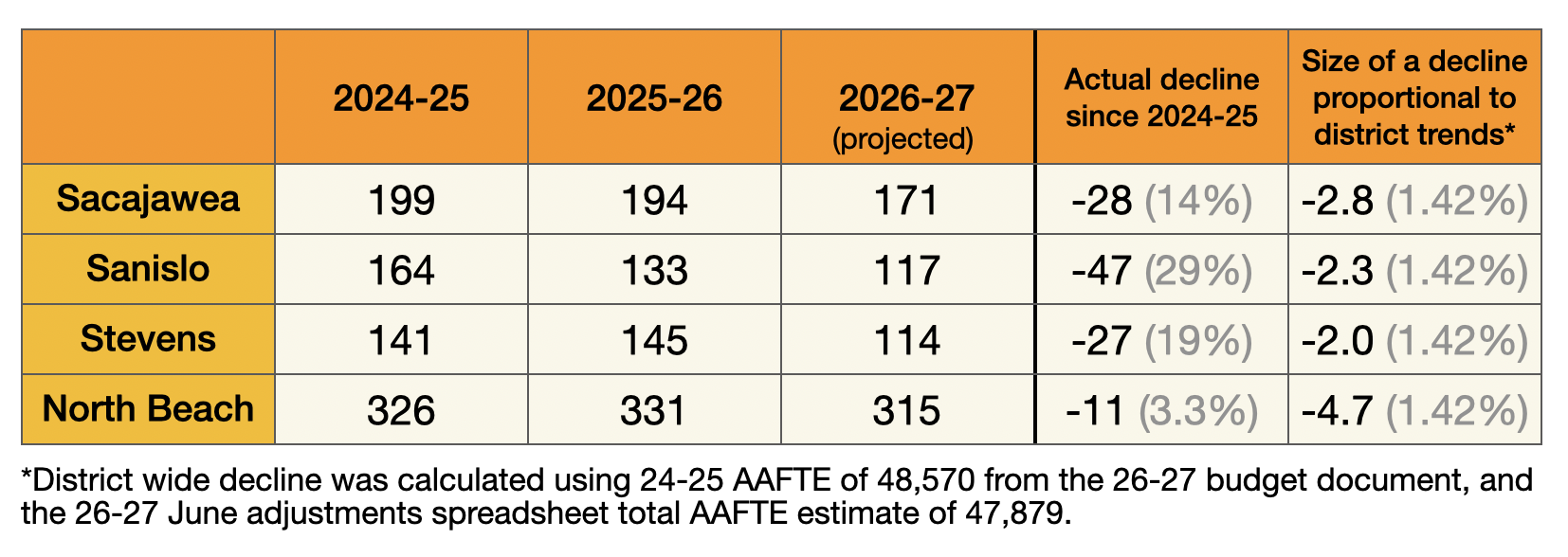
Enrollment histories for the four schools that faced concrete closure plans in 2024. All of them have lost a disproportionate number of students compared to the average district enrollment declines since 2024.
²Financial arguments for closing a school rarely make sense. District forecasts often omit costs like student transportation to more distant sites, maintenance and security of the closed building, enrollment decreases from families who leave the district when their site is closed, and the cost of preparing a building for rental or sale.
I am not planning to cover the many financial studies of past closures, and how they fail to save money, in this series. I will revisit this if the need becomes acute.
Why a Sac Closure Proposal Seems Likely This Fall
The superintendent and board discussed school mergers at a board retreat on June 13. If closures are coming to SPS, Sac is especially vulnerable. Here’s why.
This is part one of a four-part series preparing for a possible Sac closure announcement. Find the rest of the series linked here.
Once again, a disclaimer: As of this writing, SPS has not made any closure announcements. Not for Sac, and not for any other SPS school, either.
But.
There are plenty of signs that closure announcements are likely this fall. The most obvious one is the fact that the board and superintendent discussed the benefits of school mergers on June 13.
Before we get to that, though, let’s go back to some of the early warning signs of closures so we can see how they’re accelerating.
Since the first day of his tenure as Superintendent, Ben Shuldiner has been clear that closures—along with all other money-saving options—are on the table. He said it on Feb 5 (his fifth day on the job), and he’s repeated it often, including on May 14 and as recently as June 17.
In Shuldiner’s March 29 Sunday newsletter, he lists five things in the district that are “not-so-good.” The list begins:
brand new, beautiful school buildings half or even 2/3 empty,
old and dilapidated buildings close to capacity,
It’s difficult not to see the threat to Sac written between the lines here. Recall that the population of old and dilapidated Sac was slated to merge in 2024 into the brand-new, beautiful building of John Rogers, which is currently at less than half capacity. Indeed, parents rallied against closures this April after they found the subtext in Shuldiner’s newsletter alarming.
In a May board meeting, Shuldiner introduced the narrative that smaller schools are more expensive to operate. That’s a bad omen for little ol’ Sac, even though his analysis showed that our school’s costs are perfectly average.
Shuldiner thinking in these terms puts Sac at risk whether the merits of the cost/size argument are true or not. Sac is projected to be the fifth-smallest of the 55-60 SPS elementaries operating next year. At 171 students, we will only have more kids than Licton Springs (36), Stevens (114), Sanislo (117), and Sand Point (141).
In June, Shuldiner started openly shopping the idea of shutting down schools. He studiously avoids the term “closure,” opting instead for “merger,” but either verb has the same effect of displacing kids and shuttering buildings.
Shuldiner introduced the merger conversation in a board retreat slide, shown below. It estimates potential financial benefits of school closures—sorry, mergers—as being $1 million - $2.5 million per school. Community analysis from SPS's attempted closures in 2024 indicates that closures would yield savings of $600,000-$700,000 per school.
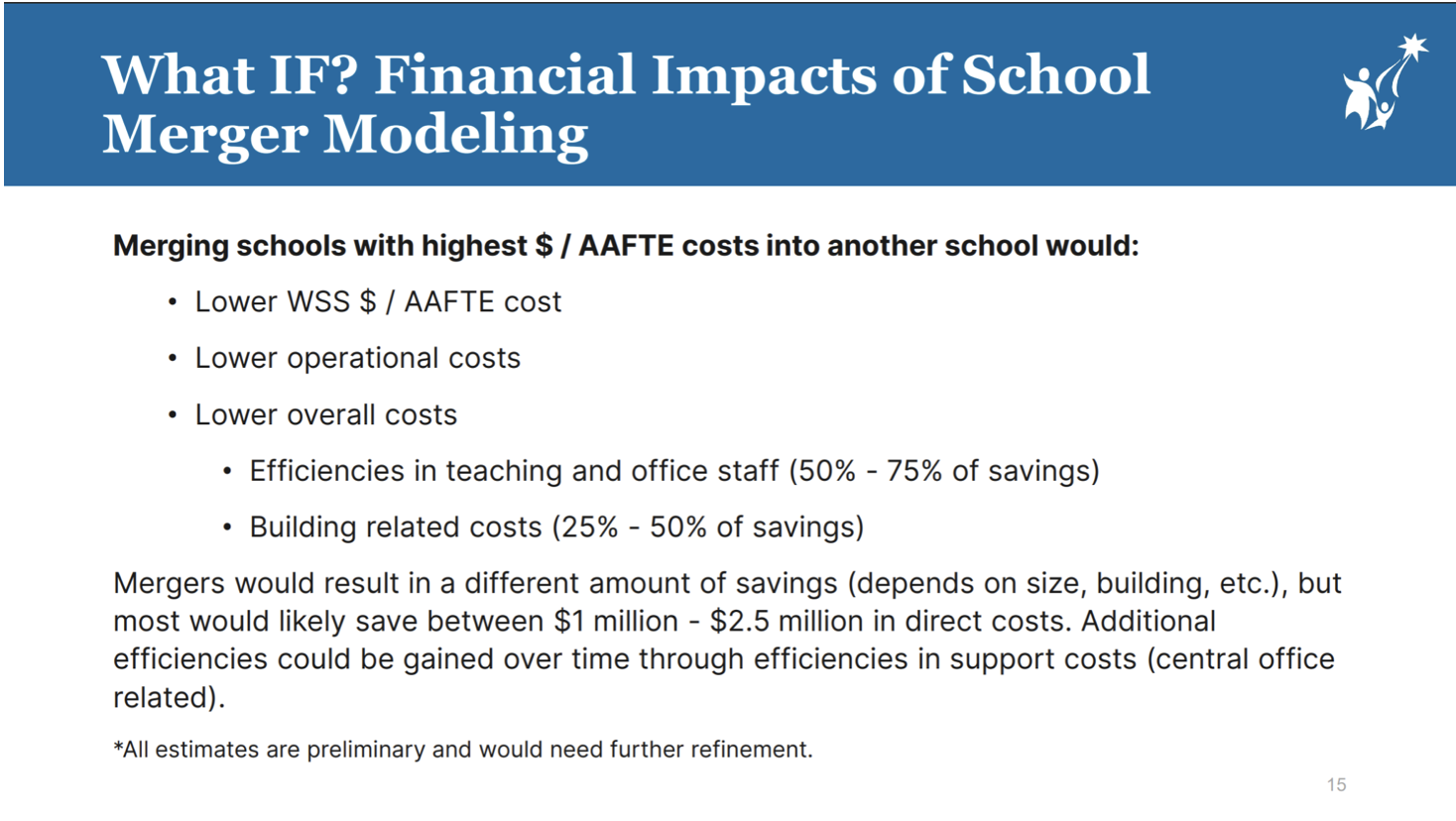
Slide from a board/superintendent work session on June 13, 2026, estimating the financial savings from hypothetical future school mergers.
Once again, though, the narrative doesn’t have to be true in order to motivate or justify a closure. In any case, it’s clear now that closures are being actively evaluated by SPS leadership.
***
If SPS pursues closures, Sac is particularly vulnerable.
In 2024, district leadership was perfectly willing to highlight the decrepit state of our building without taking accountability for the neglect that led us here. They cited our low enrollment without regard for the fact that it’s the district’s own policies that have drawn families elsewhere—and sadly, that flight has only accelerated since, which is why we lost two teachers and music for next year. In 2024, the district also highlighted our proximity to other new, empty elementaries without any reflection on their having constructed these large new buildings (John Rogers and Hazel Wolf in particular) in the first place.
We are small in both enrollment and building capacity, which are factors drawing Shuldiner’s and the board’s attention during budgeting exercises.
The community we have here is vibrant and close-knit, but that doesn’t translate into any of the metrics used for budgeting or facilities planning.
I will once again point out that these vulnerabilities—declining enrollment, crumbling building—are our problem, but they are not our fault. They are the result of district choices: The choice to build Hazel Wolf in our backyard without adjusting zoning, the choice to delay the Sac rebuild without a facilities plan in place, the choice to put our community through the ongoing uncertainty created by the 2024 closure threats, and the choice to leave us unsupported and with an uncertain future in the years since.
***
Here’s the final kicker: If Sac is to survive, simply avoiding closure isn’t enough. Our building is toast, as the kids say. It’s cooked. Keeping Sac open, in any sustainable way, requires a rebuilt facility.
Join me in part two of this series, where I discuss how the conditions of a struggle to keep Sac open have changed between 2024 and today.
Or, jump to any part of the series from its intro or using these links:
It’s Time to Prepare for a Possible Sac Closure Announcement
It is increasingly likely that a closure announcement is coming for Sac this fall. Here’s how our community can prepare.
Let’s get the disclaimer out immediately: I don’t know with certainty that any such announcement is coming. No SPS school closures have been announced, and I don’t have any insider information indicating that they’re being planned.
That said, there are a lot of public indications that closure announcements are coming to SPS this fall. If the district is eyeing closures, there is every reason to think that Sac would be among them.
I’ve been thinking about Sac’s future a lot recently. The Sacajawea community is so different from what it was two years ago during the 2024 closure debacle. That experience built a deep network of relationships, a well of solidarity, and a vast library of community knowledge about SPS systems and how they operate. Two years on, we as a group know so much more about what a closure threat feels like, what we value and will advocate for, and how to fight for it.
In the coming weeks, I will be sharing a series of short pieces to help prepare the Sac community in case a closure announcement comes for us in the fall. I don’t want us to be as surprised as we were last time.
If closure is in our future again, now is the time to build proactive capabilities so that we can participate in the process from a position of strength.
If a closure is announced, what do we want to advocate for: To stay open? To be rebuilt? To go elsewhere as a community, or for each of us to choose our own family’s next school? If the building is shuttered, what kind of hand do we want to have in shaping what happens to the property? What might it look like to advocate for any of these things, and what power and tools do we have at our disposal?
***
I’ll be thrilled if I’m wrong about a closure announcement being imminent.
But even if I am wrong, the Sac community is already under pressure from the district, whether we have acknowledged it or not. Our student population is dwindling due to uncertainty about our future. With the district unwilling to properly staff our small population, our classroom configurations are becoming dire.
We will have homerooms with more than 30 kids next year (for context, the official maximum class sizes are 17 for K-2 and 28 for 3-5). Our kids won’t get music instruction. The building has been neglected for so long that even basic maintenance is no longer a priority.
Sac is already in a struggle.
This series is my way of laying some groundwork for community organizing to pull us through. It’s my hope that what I’m sharing here will be valuable regardless of the specific form that the struggle takes.
Over the coming month, here’s what’s headed your way on Thursdays:
I hope you read along. I’ll be thrilled when the ideas I share here start to build into new ideas through community conversation. If—no, when!—that happens, please share your ideas with your neighbors, and with me at advocacy@sacpta.org.
I will also be organizing some community meetings in August, so stay tuned for those invites as this series progresses.
Farewell to Three Sac Teachers (And a Primer on Why We’re Losing Them)
June adjustments brought the loss of another Sac homeroom teacher, leaving us down two homeroom teachers and one specialist (music) compared to this year.
By now, news is spreading that Sac has been allocated two fewer homeroom teachers next year. We will all miss Nat Dahl and Erica Cox, along with our music teacher, Chelsea Toledo (“Ms. T”). I wish them all the best and the happiest of new beginnings.
The losses of Ms. Dahl and Ms. T have been known since March, when initial enrollment projections for next year were made public via the “Purple Book”.
In March, Sac was allocated one fewer homeroom teacher and one fewer specialist based on a projected enrollment of 184 students. Ms. Dahl stepped up for what’s called “voluntary displacement” which means she will have a position elsewhere within SPS in the fall.
This year’s June adjustment—the first in recent SPS history, but something that used to be standard—predicts Sacajawea to have only 171 students next fall. That projected decrease triggers the loss of a second homeroom teacher.
The displaced teacher is Ms. Cox.¹ Teachers union rules govern displacements and they are based on full-time tenure with SPS. Whoever has the shortest tenure is displaced unless another teacher volunteers for displacement instead.
***
Sac’s June adjustment is disappointing and the timing of its execution was cruel (news broke to staff the evening before the last day of instruction). That said, the idea of a June adjustment itself is one that advocates have pushed for. In theory, adjusting staffing plans in June prevents the disruptive fall adjustments known as the “October shuffle.”
Longtime Sac families will remember the chaos of the 2022 October shuffle, in which a large number of Sac students had to shift classrooms and/or teachers when enrollment surpassed projections, leading to the creation of new homerooms and addition of new staff.
Of course, whether June adjustments actually prevent October disruptions has everything to do with how accurate the June projections are. We’ll find out in the fall. Even if the low projections are incorrect and Sac gets its teacher allocations back, though, the likelihood that those slots will be filled by the specific teachers we are losing is low.²
***
Sacajawea’s June update reflects a 13-student loss from the February estimates, and a 30-student loss from where we just closed the 2025-26 school year.
Why is Sac losing so many students?
The short answer is that the new expansion of SPS choice programs for next year has drawn many families elsewhere. SPS dramatically increased its choice program this year. In the past the district has artificially limited enrollment in choice schools. This year, they filled them up to 85%-95% capacity. I wrote about this here, in December, when I also predicted that this policy would have exactly this outcome for Sac.
The real answer to the student flight from Sac, though, includes the fact that Sac has been neglected, and our stability threatened, for years. The neglect and uncertainty has created a downward spiral. I understand the families who have opted out. We are increasingly being asked to choose between a neighborhood school and a stable, functional one, but I lay the blame for that narrowing of choices at the district’s feet. These didn’t have to be the only two choices.
***
Next year, Sac will have only seven gen ed classrooms. For context, we had nine this year. Seven is by far the lowest in my eight years as a parent here, and it’s likely an all-time low. We’re breaking records, baby!
As Principal Fisk shared earlier today, Sac will have the following gen ed classroom configuration in the fall, along with our two distinct classrooms:
Kindergarten (Chrissy Jackson)
First grade (Yumee Chi-Park)
Second grade (Kit Norman)³
Third grade (Faosiyah Madres)
Fourth grade (Megan Walker)
Fourth/fifth split (Katy Maynard)
Fifth grade (Aaron Reddecliffe)
A handful of these folks are going to be teaching a grade level that they haven’t historically taught at Sac. I have full faith in them, but I don’t envy them the task of prepping anew.
Student classroom assignments are released in the fall, usually in the week before school begins.
***
Because the news of Ms. Cox’s displacement came so late—for her and for the rest of us, there was no time for proper farewells. Staff chose not to tell the students about the upcoming change, having just learned about it themselves.
Stay tuned for details of a casual, PTA-hosted farewell for Erica and the rest of the departing staff. We’ll announce it as soon as the details are settled. And we’ll make sure to let everyone know how to send well-wishes for those who can’t be there themselves.
~
1. Displacement is not the same as termination. If she chooses, Ms. Cox can join the pool of displaced teachers who get preferential placement at the schools where June adjustments led to an increase in teacher count, or schools where positions open up over the summer.
2. To be eligible for the right of first return to a new Sac position, a homeroom teacher has to be employed full time as a teacher elsewhere at SPS (substitute teaching does not qualify). Assuming teachers choose this path, their return to Sac would then require them to abandon their new classroom one month into the school year. Many teachers decline to do this because of the disruption it causes. I have no judgment on either choice, and will note only that this policy puts teachers in an uncomfortable position no matter what they choose.
3. Next year’s second-grade cohort is large. I’m not 100% sure, but I believe this cohort contains over 30 students! While a handful of them are also supported in distinct classrooms and will spend minimal time in the gen ed room, that’s still a lot of kids in one primary class. Not to mention the huge disservice this does to the distinct students by increasing the barriers to their spending time with their gen ed peers in such a populated setting.
No Hate in WA State, and Why Aren’t Books Part of SPS Middle School ELA?
“No Hate in WA state” is fighting to defeat two Nov. ballot initiatives that target LGBTQ+ students. Plus: Why aren’t books part of the SPS middle school ELA curriculum?
I’m popping in on this last full week of school to share two things, and to wish everyone a summer of tranquility and delights! After the ice cream social and field day, that is.
Before we all go on break, please take two minutes to learn about these two items of note:
No hate in WA state (look out for these school-focused anti-LGBTQ+ bills over the summer)
Books aren’t part of the SPS middle school ELA curriculum. They really should be.
No hate in WA state
Two school-related initiatives on Washington’s November ballot are gaining attention:
IL26-001 (“Parents’ Bill of Rights”): If passed, this initiative would give parents the rights to obtain their children’s school records, including records of medical treatment, mental health and other counseling, and any other documents maintained by the school. This is a danger to LGBTQ+ youths for whom school is a place to safely seek help when their families are unsupportive. It’s also a danger to children whose home situations are abusive.
IL26-638 (Trans girls sports ban): If passed, this initiative would ban trans girls and women from playing on female school-based sports teams. The initiative would also require physical genital check certifications for all members of female students sports teams. Players on all-male teams are excluded from the terms of this bill.
Seattle school board members Gina Topp and Liza Rankin have endorsed the “No Hate in WA State” campaign fighting against these two initiatives. So have many, many other Seattle organizations and public figures. You can add your name to the campaign as an individual endorser, as I have done.
You can also join us at the campaign kickoff event this coming Wednesday, June 17, at Neumos. I’ll be driving. If anyone would like a ride, just let me know at advocacy@scapta.org!
Note for the legal sticklers: While PTAs must avoid endorsing political candidates, it is acceptable for PTAs to express opinions on ballot initiatives. That said, and as usual, any opinions in LSBW are solely mine and do not necessarily represent the views of the Sac PTA.
Books aren't part of the SPS middle school ELA curriculum. They really should be.
Did you know that books aren’t part of the official ELA curriculum in SPS middle schools? Some teachers are able to squeeze in a book on their own initiative, but many don’t. A handful of teachers were even disciplined this year for trying to teach novels!
I wrote about this tragic and bizarre situation here. I also gave a two-minute public testimony about it at last week’s board meeting, if you prefer video. My hope is to get SPS to grant teachers more freedom next year in their choice of texts, and then to replace the terrible middle school ELA materials.
If you’ve got kids heading into middle school soon, I think at least the intro to the article is worth your time.
Update (June 15, 2026): I spoke about this issue on the City Cast Seattle podcast. The SPS-focused portion is the first ten minutes or so, but if you keep listening you get to hear about the trial underway over the future of Seattle’s nude beach! 😎
There’s Something New for Everyone this Week
No matter what your special interest is, this week brought an announcement of something new on the way just for you: sports fields, math pathways, and more.
No matter what your special interest is, this week brought an announcement of something new on the way just for you:
📱📵 For those concerned tech in schools, a district-wide cell phone policy goes into effect on Monday.
🏈 ⚽️ For our littlest sports fans and players, SPS is soliciting feedback on the design of new athletic fields coming to Lower Woodland Park in a few years’ time.
🧮 🤓 For our young math enthusiasts, SPS has just introduced new accelerated math pathways for students transitioning into middle school.
📚🐛 For our budding bookworms, SPS has just adopted a new K-5 English Language Arts curriculum. It will arrive in Sac classrooms in September. (I’ll write about this one separately.)
🏛️ 🇺🇸 And finally, for the civic-minded among us: last week’s rally against school closures made the news! Thanks to Sac’s very own IA Aaron Moore for speaking at the rally. You can hear him in action in the linked clip.
There’s something for everyone!
Jump ahead for more detail on:
New cell phone policy takes effect Monday
At yesterday’s school board meeting, Superintendent Ben Shuldiner announced a new district-wide cell phone policy that will take effect this coming Monday—four days from now!
The policy is different for grades K-8 and 9-12:
K-8: Away for the Day. Cell phone use is not permitted at any point during the school day. Phones, if present, must be stored in lockers or backpacks. This policy applies in SPS’s elementary, middle, and K-8 buildings.
9-12: No Cell Bell to Bell. At SPS, this means that cell phone use is not permitted between the bells that mark class periods. Phone use during passing periods and lunch break is ok. This policy applies to SPS high schools.
Confusingly, in most places nationwide where the phrase “No cell bell to bell” is used, it refers to the stricter policy that SPS has named, “Away for the day.”
Exceptions are made for students who require phone access for medical needs (glucose mointoring, for example), language access (translation apps), or for documented IEP or Section 504 learning accommodations.
Smart watches and other electronic devices are also exempt from the policy, for the time being at least. The district already has a policy in place prohibiting the use of personal laptops in class.
Shuldiner said yesterday that many principals and teachers have been asking for a district-wide cell phone policy, and are eager to implement it on Monday.
When board members asked what consequences students would face for breaking the policy, Shuldiner said that the disciplinary handbook would apply to these infractions just like it would for other misbehaviors.
Some board members, particularly Director Evan Briggs, think the high school policy doesn’t go far enough. Briggs was adamant that “Away for the day” is the better choice for everyone, including high schoolers, and she cited research backing this claim. Shuldiner argued that because SPS high schools have open campuses—meaning that students can leave school grounds during the lunch break—this would be too difficult to enforce.
The Seattle Times covered the new cell phone policies here.
New athletic fields are coming to Lower Woodland Park
SPS is fielding—get it?—three proposals for adding a new football field to Lower Woodland Park. Although the new field will be managed by Seattle Parks and Recreation, it will also be the home athletic field for SPS’s Lincoln High School, which is why SPS is involved.
The proposals differ in their placement of the new field (see photo), as well as in their impact on existing fields—some proposals upgrade or move the existing soccer field—and their impact on trees and parking. The proposals range from $8.6 to $11.5 million, with estimated completion times ranging from fall of 2028 to fall of 2029.
The details of the three proposals, as presented by SPS in a community meeting on Saturday, can be found here. More detailed coverage of the field development process and Saturday’s meeting is in the The Bulletin, written by yours truly.
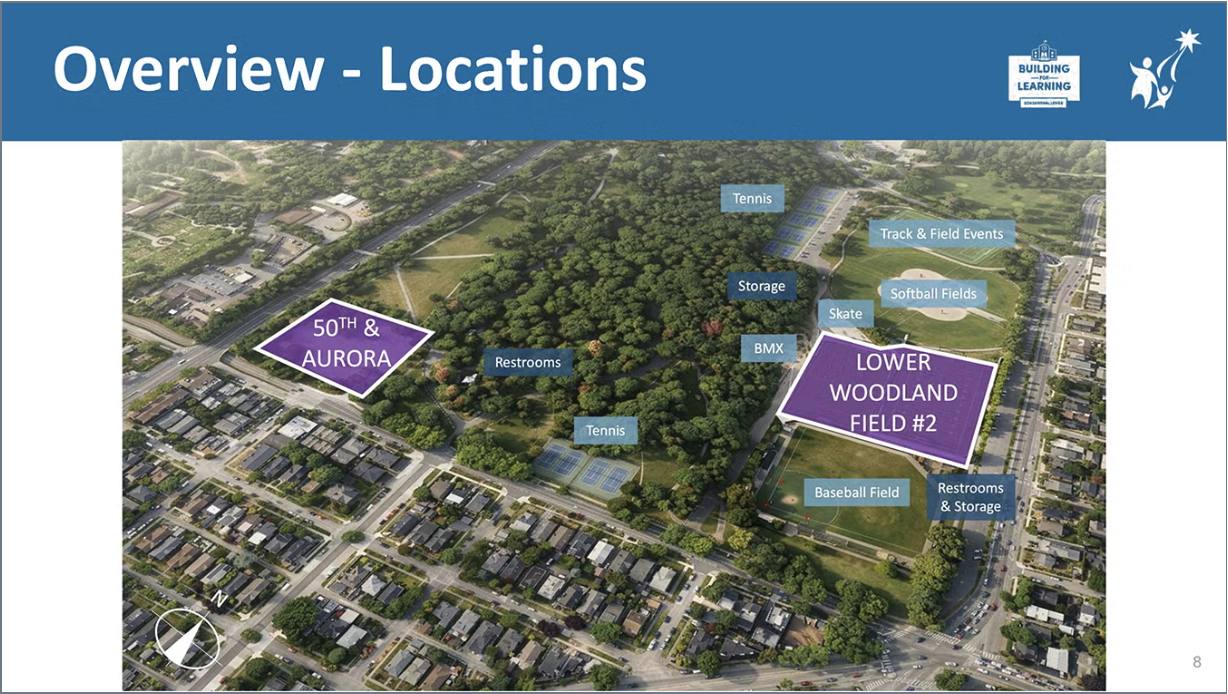
Lower Woodland Park, with purple boxes showing the two locations where football and/or soccer fields would be built under the three proposals being considered. This is an SPS slide from the April 25 community meeting.
Public feedback is encouraged here until May 9. SPS will choose a final proposal over the summer, and it will then go to Seattle Parks and Recreation for approval and next steps.
Readers who frequent Wallingford may know already that the Lincoln building abuts a public park which is also adjacent to Hamilton Middle School. While this park is the most obvious site for a school field, community pushback from some Wallingford neighbors during the original planning phases led SPS to drop Wallingford Playfield from consideration. That decision appears to be final.
Lincoln reopened in 2019 after a rebuild as the only comprehensive SPS high school without an athletic field. Since then, Lincoln athletes have been bussing to other facilities for practices and games. At the community meeting, one parent described that her daughter buses up to Ingraham High School (five miles north) for track practice. Practice starts at 7pm after Ingraham athletes are finished using their facilities, with the Lincoln students returning home after 9pm.
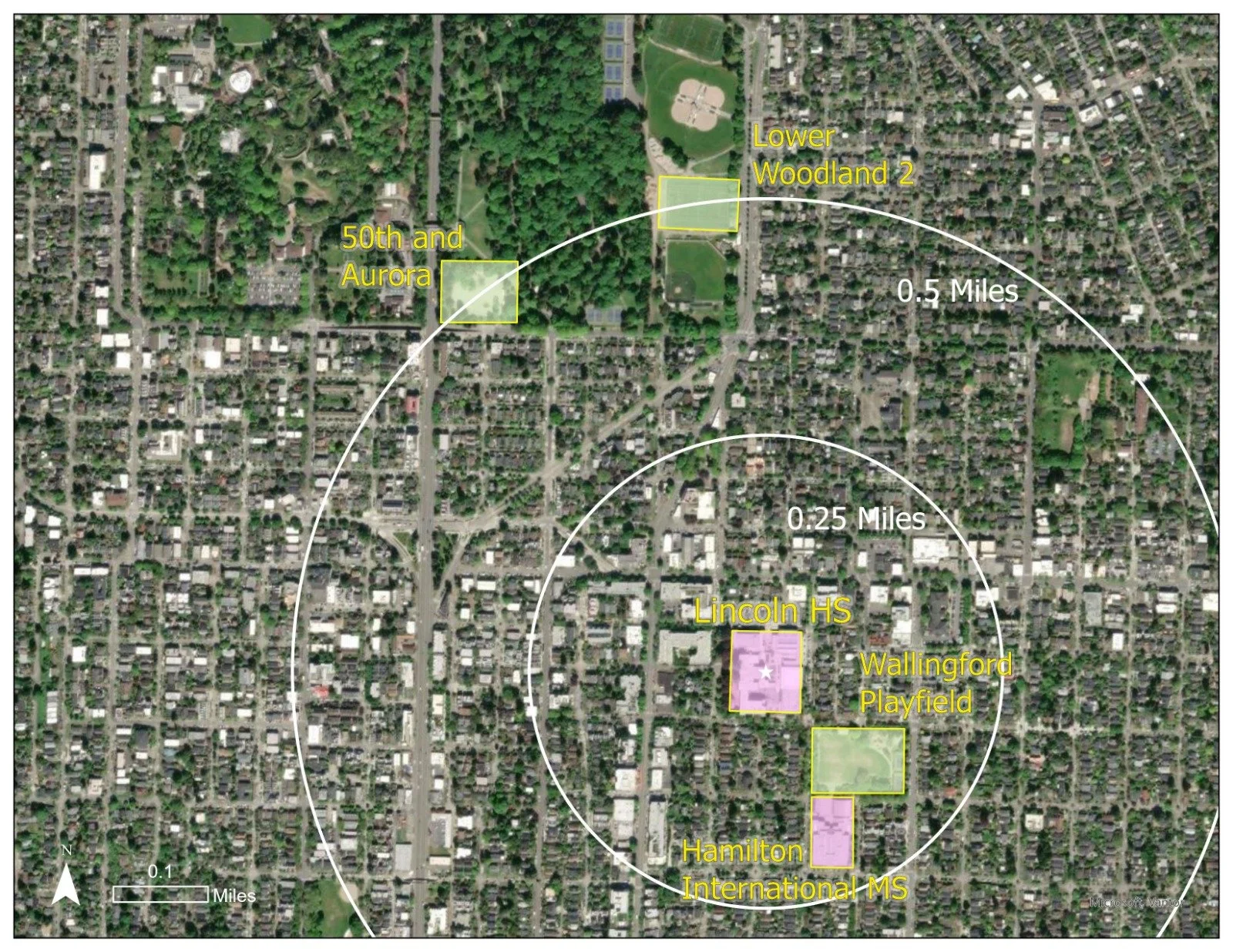
Aerial view of the Wallingford neighborhood showing: Lincoln HS and Hamilton MS (pink); the adjacent Wallingford Playfield no longer being considered as a location for the athletic fields (green, lower right); and the sites involved in the three field proposals currently being considered (green, top). Illustration by Beth Day.
Accelerated math options for graduating fifth graders
At last Wednesday’s board meeting—and in Superintendent Shuldiner’s most recent “Sunday email”—SPS unveiled a new pathway that would allow math-adept students at neighborhood schools to accelerate into advanced math classes. The program was successfully piloted last year.
The new program will advance its students by two years (in math only) during the year after fifth grade. Doing so will place them on par with peers who attended HC cohort schools by the start of seventh grade.
The acceleration involves taking sixth grade math as an online, self-paced, 12 -week course during the summer after 5th grade. Then, in sixth grade, students will take the accelerated math 7/8 class that is already offered at every SPS middle school. This will align them to the existing HC math track: algebra in seventh grade and geometry in eighth, with calculus taken in the junior year of high school.
The presentation did not clarify how geometry will be provided to all students accelerated in this way when they hit eighth grade. Today, geometry is taught only at the middle schools that host HC cohorts. Jane Addams Middle School (JAMS), which is the middle school that Sac students attend by default, is already such a school.
Letters of invitation to the families of this year’s 555 eligible fifth graders went out on April 23.
Eligible students include those who are HC-designated but chose to remain at their neighborhood school (Sac has nine such students). A quarter of invited students are not HC-designated, but were identified via their performance on the math component of the MAP assessment.
The online course will open as early as May, though participating students certainly don’t have to start that early. Highly Capable Director Dr. Paula Montgomery mentioned that some elementary teachers might be able to support students who begin the online course during the final months of their fifth grade year.
With this new program in place, roughly 23% of next year’s SPS sixth graders will be taking math 7 or above.
Details of the school board’s discussion of the new math pathways can be found in Issue 28 of The Bulletin.
April 22 Rally Against School Closures
Parents and community members, including some from Sac, are planning a rally against school closures outside the next school board meeting.
Eighteen months after the calamitous school closure announcements of 2024, some parents and community members are worried that SPS winds are beginning to blow once again in the direction of closures. They are holding a rally at the next school board meeting to oppose closures. The rally is at 3pm on April 22, outside of the John Stanford Center for Educational Excellence (also known as JSCEE, where the board meeting will be held at 4:15pm).
To be clear: No closures have been announced, nor are closures being publicly considered at this time.
Nevertheless, Chris Jackins, one of the rally’s organizers, told me when we spoke that he is concerned about recent comments made by Superintendent Shuldiner. He pointed to a Seattle Times article in which Shuldiner is quoted as saying, “It is tough because (closing a school) is a big deal for people…But in all reality, 50,000 kids in 100-plus schools is imbalanced when you compare it to pretty much any school district in America.” The flyer advertising the rally points out that the superintendent’s previous district in Michigan has a school balance very similar to Seattle’s.
Shuldiner’s “Sunday emails”—which I personally appreciate as a functional and symbolic shift toward transparency—have included closure-adjacent nods as well. In the May 29 issue, Shuldiner’s list of things that aren’t going well in the district started with, “brand new, beautiful buildings that are half or even ⅔ empty,” followed immediately by, “old and dilapidated buildings close to capacity.”
It doesn’t take a genius to connect these dots. Sac, which is very obviously dilapidated, was meant in 2024 to merge into John Rogers, which is brand new and still more than half empty.
Concerned parents and community members want to get ahead of district momentum when it comes to closures.
Sara, a retiree living in the Sac neighborhood, told me that she plans to attend the rally to send a signal to the district that closures will be fiercely opposed. Her daughter attended Sacajawea in the mid-aughts, when SPS last tried to close the school. Sara was part of the successful fight against closure back then, organizing rallies and speaking with media.
Another Sac parent, this one with kids currently at the school, is going further and helping to organize the rally itself. She said that her family’s switch to Sac has been transformational for her kids, who finally feel comfortable attending school. This is something she is willing to fight to protect.
If you’d like to add your voice to the mix, here are the rally details once again:
WHEN: Wednesday, April 22, 3pm. The associated board meeting starts at 4:15pm, but there is no expectation that rally-goers attend the meeting.
WHERE: John Stanford Center for Educational Excellence. The rally will be outside of JSCEE, which is the SPS central administration building in SODO where school board meetings are held.
See you there!