
Sac Teacher Roster to Shrink Next Year
Every March, SPS provides individual schools in the district with enrollment projections for the following year, and the staffing allocations that the district will provide to support the students in their projections. Sacajawea’s enrollment is projected to drop next year, which means we will be losing a few important staff positions for 2026-27. Specifically, we are set to lose:
One general education homeroom teacher. This drops Sac to eight, from the nine that we’ve had for the past several years.
Either our art or our music teacher. This leaves us with only two specialist roles instead of three (PE being the third).
We will gain one instructional assistant position for special education programs, taking us from ten to eleven. All other staffing levels will remain the same (front office, library, social work, preschool, special education homeroom leadership, our 1-day-a-week nurse, etc.).
This loss of staff is happening because the district projects significantly lower enrollment for Sac next fall: They expect only 184 K-5 Sac students, compared to the 202 that we have as of the most recent count in February. For context, Sac’s K-5 enrollment has been consistent in the years since the pandemic, ranging from 196 to 202.
Below, you’ll find answers to:
What is Sac losing (in more detail)?
The two difficult changes for Sac are the loss of core instructional staff: one homeroom teacher, and one of our three specialists.
Loss of a gen ed homeroom allocation
Losing a gen ed homeroom allocation next year means that one of our core homeroom teachers won’t be returning. Generally, the teacher to go is whoever has least seniority with the district, unless another teacher volunteers to leave.
As of this writing, I haven’t been able to determine who among Sac’s homeroom teachers has least seniority; whether anyone might volunteer to transfer; or whether the likeliest outcome for the lost teacher would be a transfer within SPS versus the loss of their job. Yes, there is a lot of uncertainty here!
Regardless of who Sac loses, the classroom split situation is likely to become more complicated. As we all know, Sac is already relying on many split-grade classrooms to compensate for staffing allocations that don’t get the job done cleanly.
In the coming weeks, Principal Fisk will determine classroom configurations, in a process that includes the Building Leadership Team (BLT) and a full-staff vote. This is when next year’s split situation will become clearer.
The final classroom configuration determines which cohorts of students get grouped where: How many second-grade classrooms, how many 2/3 splits, how many kindergartens, etc. Classroom configurations do not assign specific teachers or specific students to each bucket. That process comes much later, over the summer.
Loss of a specialist
Sacajawea will lose either our art or music teacher allotment. That choice is made at the school level. For Sac, the decision will be (or possibly already is) made by a staff vote, but it isn’t yet public.
For many years, Sac offered only PE and Art. Music class was added back in only a handful of years ago (I believe it was in 2022, though I could be off by a year).
Historically, SPS has prioritized art over music. The Gold Book—an SPS document that provides general guidance about budget implementation priorities—used to include a directive to staff PE and art before music. That directive is gone now, but many families and staff, including the Sac community, have recent, direct experience of a school that offers art and PE without music (versus the other way(s) around).
Why are we losing staff allocations?
I’ve split this into a short version for folks with robust, fulfilling lives (what is that like?), and a longer version for my fellow nerds.
The short version of lost staff allocations
The district expects Sac’s K-5 enrollment to drop meaningfully next year, to 184 from our current 202 (202 is per February’s P223 monthly enrollment report). That’s a 9% drop in our K-5 population.
The district uses a formula to allocate teacher slots to buildings based on the student population. The expected population decrease is significant enough that the formula yields one fewer teacher.
Specialist roles (PE, art, music) are allocated as a multiple of the number of FTE gen ed teachers. The drop from nine teachers to eight pushes Sacajawea below a rounding threshold, resulting in the loss of half of a specialist role. Because our art and music specialists are already half-time, and because PE must be full-time for Sac to remain compliant with rules relating to student exercise, we will end up losing either art or music.
The nerdier version of lost staff allocations
Every March, SPS releases enrollment projections for each school site, broken down by grade (see below for Sac’s projections). The district uses a formula called the Weighted Staffing Standard (WSS) to compute the number of teachers that each site will receive, based on the number of students in each grade. Different grade levels have different funding ratios: K-1 students receive 1 teacher allocation for every 21 kids, while the ratio is 22:1 for grades 2-3, and 28:1 for grades 4-5. All of this is outlined in what’s known as the “Purple Book”.

Sacajawea’s 2026-27 enrollment projections, from the Purple Book
[A side note on WSS ratios: The WSS funding ratios above have changed this year. In all grades except 2-3, the district has increased the count of students that “earn” a teacher allocation. For example, last year, the K-1 ratio was one teacher allocation per 20 students; this year it’s 1:21.
These WSS changes do not affect Sac’s 2026-27 situation (I ran the numbers to verify). But they will certainly lead to fewer teachers being allocated district-wide. Indeed, that is the point, as the ratio change was described as saving roughly $8.5 million in staffing costs, in a board budget meeting on March 4.]
How do gen ed teacher allocations work?
For those who want to get really nerdy, here’s how Sac ends up at 8 teachers:
47 projected K-1 students at a 21:1 ratio yields 2.238 FTE
59 projected 2-3 students at a 22:1 ratio yields 2.681 FTE
78 projected 4-5 students at a 28:1 ratio yields 2.786 FTE
That’s a total of 7.705 FTE, which gets rounded up to 8 teachers.
In order for our allocation to increase to nine gen ed homeroom teachers next year, our projected enrollment would have to yield 8.51 FTE in the WSS formula. This would require one of:
17 more K-1 students; or
18 more 2-3 students; or
23 more 4-5 students; or
Some weighted combination of the above
Clearly, the distance between our projected enrollment and what we’d need in order to receive nine teachers is more than just a handful of kids.
How do specialist allocations work?
Specialist roles are allocated at 12.5% of the school’s gen ed teacher allotment. We are being allocated 8 gen ed teachers, so we should be getting 8 x 0.125 = 1.0 specialist slots. In fact, we will be receiving 1.5 specialist slots. SPS is doing Sacajawea a favor on this one!
It turns out that SPS has actually been doing Sac this favor–the favor of a bonus 0.5 specialist role–for several years now. For the current 2025-26 academic year, we qualified for only 1.5 specialist FTE, but we’ve received 2.0. I only realized this as I was working through the numbers for this article. So, no, I have no idea (yet?) why Sac has been–and still is–getting this small bonus.
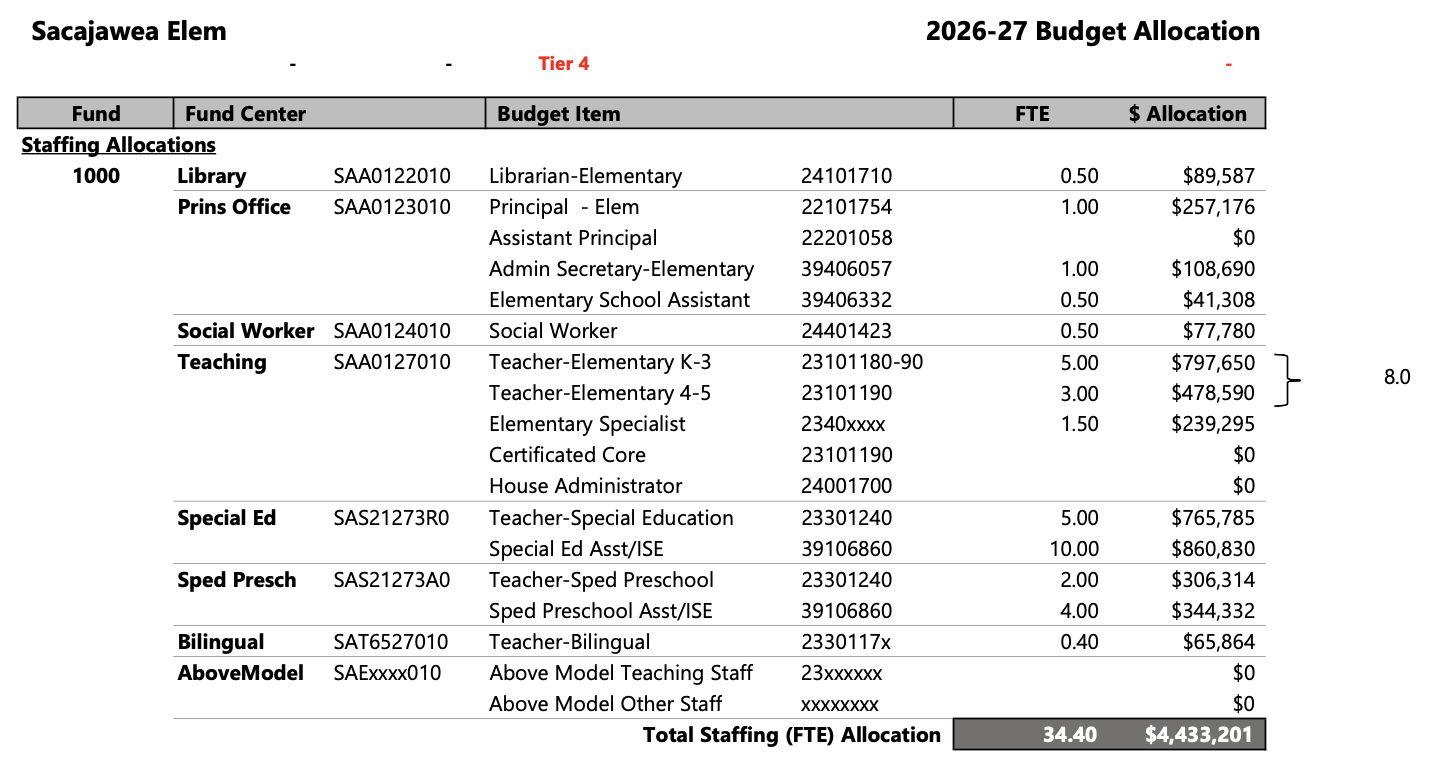
Sacajawea’s 2026-27 staff allocations, from the purple book.
Are the enrollment projections accurate?
In the past, SPS enrollment projects have been wrong for Sac. Those of us who were around in 2022 recall the “October shuffle” in which we gained not one, but two additional teachers, because enrollment was so much higher than the projections made in the Purple Book.
That said, I suspect the projections may unfortunately be accurate in this case. The next section explains why.
Why are Sac’s enrollment projections so low?
SPS doesn’t provide rationale for the Purple Book’s enrollment projections, so we can’t say for sure.
But.
I suspect that this is a consequence of the changes made this year to the choice program–more specifically, the increase in capacity at Hazel Wolf next year. I predicted this enrollment drop here when the choice changes were announced back in December.
There are three reasons why I believe Hazel Wolf accounts for the significant decline in Sac’s projected population:
First, SPS projects that Hazel Wolf’s enrollment will increase by 87 students next year–a 13.2% increase. Hazel Wolf is very close to Sac–closer than Sac is, for many families. 25% of Hazel Wolf’s K-5 students live in Sac’s geo-zone. Worse, 32% of Sac-zoned students attend Hazel Wolf instead! Clearly, there is an appetite among Sac’s neighborhoods to attend the newer Hazel Wolf, whose future is less uncertain.
Hazel Wolf’s population has been kept artificially low until now, but next year the building will be used to its full capacity, and this opens up a lot of new spots for Sac-zoned families who haven’t been admitted in the past.
Second, recall that Hazel Wolf is a choice school. Families apply to send their students there. SPS has those applications–and indeed, by this time of year they already know who they’ve assigned to each choice school. The district already knows which additional Sac-zoned families it is allowing to switch to Hazel Wolf next year, and they would have factored that into Sac’s enrollment projections.
Third, a comparison of Sac’s current enrollment vs. next year ‘s projections shows that SPS expects the population loss of 17 kids to come from the students who are already attending Sac today. This is not a matter of an incoming kindergarten cohort that doesn’t replace the students completing 5th grade. SPS projects Sac’s incoming kindergarten class next year to have 22 kids; our current 5th grade cohort has 23 students.
While some annual student movement is normal, to my mind only something systemic could account for the loss of 17 already-enrolled students from Sac in one year. The sudden increase in capacity at Hazel Wolf fits the bill. I can’t think of anything else happening in our area that would explain such a sudden, large potential population drop. If you can, please let me know at advocacy@sacpta.org!
Why does it matter whether Hazel Wolf is the reason behind Sac’s possibly dwindling population?
If the enrollment drop is indeed caused by students leaving for Hazel Wolf, this means that Sac’s struggles are the result of district policy choices–it’s not an organic thing, and it’s not inevitable. Policies are choices, and choices can be made differently.
Sac’s current building state–not great, we all agree!--stems from choices the district made, over and over, to neglect the building. A building crumbles organically, but the decision not to intervene–that’s a choice. Cancelling rebuild plans is a choice.
Hazel Wolf opened in 2016 in Sac’s backyard; Olympic Hills, just to our north, opened in 2017; the new John Rogers opened last fall (2025). To construct these huge, nearby schools in an environment of long-term enrollment decline–that’s a series of choices. To do this without any rezoning to balance the student populations across the schools over a decade–that’s also a choice.
The new school choice policy that allows more flexibility for families is also–you guessed it–a choice! In my opinion, this new policy is one that is actually good for the district. We need more flexibility for families. Still, if I was able to predict the effects this change would have on Sac, surely someone at the district predicted them as well, right? To yet again ignore the negative consequences for Sac–well, that’s yet another disappointing choice.
I am beyond tired of watching the district make choices that leave the Sac community with fewer resources, more deterioration, and less clarity about our future year after year. Why are we squeezing families into a false choice between their neighborhood school and a fully-staffed one?
I’d like us to remember: The problem is not that our community is organically withering. The problem is that we are being strangled by the district’s choices.
Can the PTA mitigate these losses?
This section is an addendum, written to answer the many questions I received after the original post was published. Most of the questions related to whether the PTA can use its money hire back some of the lost staff.
Overall, the answer is no, the PTA can’t really help here. Read on if you’re interested in the nuances!
How much would it cost for the PTA to hire back a half-time specialist or full-time teacher?
The cost of 0.1 FTE is roughly $20,000. So, the cost of restoring a half-time specialist would be over $100K, and the cost of hiring a full-time teacher is over $200K. Positions half-time or more earn benefits, which the PTA would have to cover, which makes them cost even more.
$100K or more is simply beyond the capability of our PTA. Even with a specialized fundraiser focused on this, I do not believe that we could raise this level of funds. For context: Sac’s PTA has raised a total of around $50k so far this year, and our major fundraiser—the direct ask—is behind us.
If we had the funds, could the PTA hire back the lost staff?
Maybe. There’s a philosophical issue here, and a logistical one.
Philosophy
The philosophical issue is whether the Sac PTA is comfortable spending its budget on staff. Several years back, the we had a pretty strong stance against doing this. The stance was rooted in an equity concern: Many schools do not have the PTA resources to cover staffing gaps in this way, so it’s inequitable to buy our way into improved staffing when others can’t. It’s been a few years since we discussed this as a group, so I can’t say how today’s PTA membership would feel about it.
Our PTA has, however, funded 0.1 FTE (a half day) for a reading specialist, in the past few years. This brings the Sac reading specialist up to 0.5 FTE, which provides more time with the kids and also more stability in the role itself. It is difficult to retain staff in a 0.4 FTE position, especially since such positions do not come with benefits.
Timing
The timing issue is that Principal Fisk needs to finalize the budget and staffing by late March. So, if we wanted to hire back any staff, the PTA would have to make that commitment in the next week or so. Specifically, we’d have to commit before we had the time to explore fundraising options or understand how effective we could be at raising those funds. That would be hugely risky.
That said, nothing prevents us from starting a discussion or fundraiser now with the intent of addressing any likely, similar staffing gaps for the 2027-28 academic year.