Thank you to the 25 or so folks who turned out on Monday to share your thoughts and concerns with school board director Liza Rankin! Thanks to the volunteers who kept things on track as I was knocked out by the flu. I’m sorry I couldn’t be there.
And, of course, a huge thank you to Director Rankin for sharing her time and listening!
Here’s a fairly detailed summary of the conversation for those who couldn’t make it. This is based on written and audio notes, and it was revised by several parents who were present in the room. We’ve organized the discussions into themes loosely inspired by the list of community questions assembled by the advocacy team.
Because Director Rankin is not currently privy to details of the merger plans, the purpose of the conversation was to share community concerns and hear any opinions or context that Rankin was able to share.
Core themes:
Long-term facilities & zoning plans
Why merge Sacajawea into John Rogers, specifically? When will rezoning happen?
Rankin agreed that a combined Sacajawea + John Rogers zone doesn’t make sense and that she’s not sure why this is the proposal. She assumes that rezoning will happen as a next step after closures.
Rankin was emphatic that displaced families would not be forced to move again because of rezoning: “This is a hill I am willing to die on.” Her preference is that boundaries updated in the future would only apply to incoming families.
Why not rebuild Sacajawea? What will happen to the levy money earmarked for “an unnamed NE elementary school”?
Rankin acknowledged that past decisions to build new, large schools like Hazel Wolf, Cascadia, and Thornton Creek in an environment of enrollment decline have left the district with excess capacity.
She said that earlier Sac-related levy decisions were based on the building condition instead of an assessment of whether a new building here makes sense. She did not offer possibilities for use of the BEX VI levy money earmarked for “an unnamed NE elementary school”.
Is the district taking future population growth into account as it closes schools? Could future population growth or less enrollment in private schools make a Sac rebuild worthwhile?
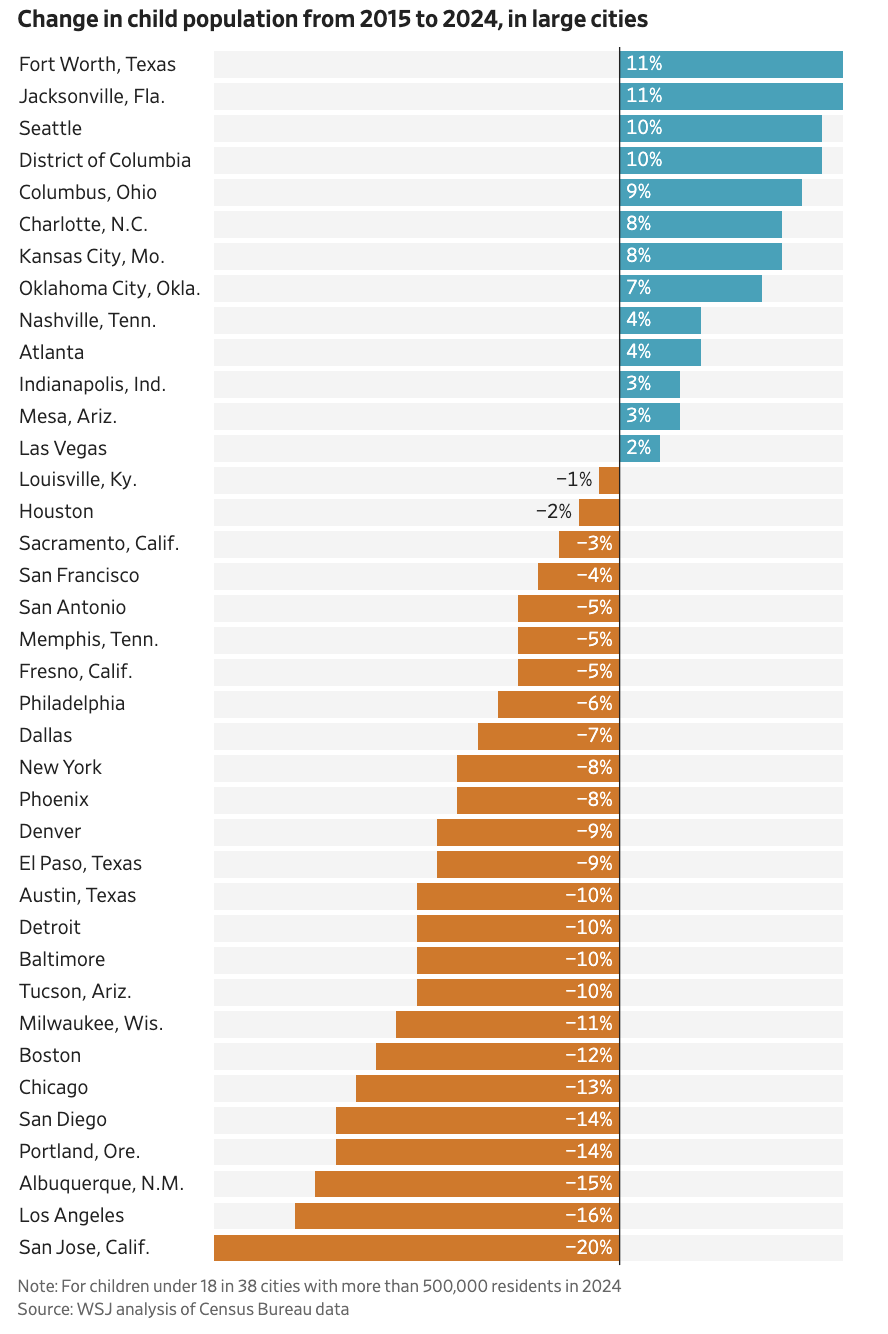
Community members suggested reasons that capacity at Sac might be useful in the future. Some mentioned that Seattle’s youth population is growing, citing this Wall Street Journal analysis of census bureau data and abundant local construction. Because the article is paywalled, I’ve put its key findings at the end of this article.
Rankin responded that Seattle’s youth population is in decline, actually, most acutely in the area around Eckstein and in West Seattle.
Rankin also pushed back against community frustration that SPS is increasingly losing kids to private schools. She said that the share of Seattle families choosing private school—currently 25%—has been steady for the past 40 years.
[Author’s note: The Seattle Times reported in 2024 that Seattle’s private school share had just reached 25% but had hovered between 20-22% from 2010-2018. The difference between 22% and 25% is more than 2,000 students. The total number of students who will be displaced by the 2026 merger proposals is less than 1,600, for context.]
Rankin additionally said that private schools are facing closures just like public ones. She did not name any when asked, but said instead that the Waldorf school near her house is looking at split-grade classes.
[Author’s note: U Prep, a private 6-12 school less than a mile from Sacajawea, expanded its campus to include new buildings in 2023. The Perkins School, a private elementary a half mile walk from Sac, added new classrooms in 2019. Lakeside added a new building to their 20-acre campus this spring.]
Special programs
What will happen to families who rely on Sacajawea’s on-site Boys & Girls Club?
Parents expressed concern that after care won’t be available where it is needed. The John Rogers aftercare is full today, and some JR kids already bus here after school to use Sac’s BGC. Rankin understandably had no answers about this but she made notes to take back to the district.
What will happen to special ed students if/when there aren’t available seats in the program they need?
Rankin said this is another hill she’ll die on but she didn’t specify what that means.
A Sacajawea staff member raised concerns that the merged Sac+JR will have an exceptionally high number of special ed caseloads. She was skeptical that a single principal would be able to adequately supervise this number of IEPs.
[Author’s note: Sac has 64 special ed students (including 17 in pre-K) and JR has 59. They sum to 123. For comparison, here’s the number of special ed students at nearby SPS elementaries: Olympic Hills: 88; Olympic View: 54; Wedgwood: 33; Baldwin: 52 (73 if Cedar Park merges fully); Hazel Wolf: 99, with 67 in K-5 and 32 in 6-8. Numbers are from the Sept 2026 P223 report.]
Family choice
How many families will get their choice in the choice process?
Rankin did not know, understandably, but she reiterated Shuldiner’s promise that displaced families will get first priority in the choice process.
A community member pointed out that Sac families won’t actually get full choice because Hazel Wolf is already full. Rankin said that isn’t necessarily true, citing different definitions of “full”.
[Author’s note: Hazel Wolf is filled to its physical capacity. Its enrollment was 680 as of September and its operational capacity is 691 students.]
What kind of supports can SPS offer merging families?
Community members asked for tours, open houses, etc. at the newly merged schools before the choice process closes. Rankin said she thought those were reasonable requests.
Building use
What will happen to the Sac building? What will be done about the physical and spiritual hole in the community?
Rankin confirmed that future building use is a board decision.
She listed out her personal dreams for unused spaces, including early learning centers, inclusion case study schools, or environmental learning centers. She then acknowledged, “These dreams are not connected to reality,” and said that she can’t make any commitments about what will happen to Sacajawea specifically.
Community members expressed concern that SPS will leave the site vacant. Some expressed skepticism that any community organization would want to use the space without significant remodeling.
Will the playgrounds remain accessible as the district determines the building’s future?
Rankin said she’s heard concerns about playground access at other places, too. She also said that she understands the countervailing concerns about people lighting fires, letting dogs roam, and so on.
Misc extras
What’s the timeline for this process?
Rankin reiterated that Shuldiner is meeting with staff and families through mid-December. The board will then receive a proposal from him and will likely vote on it in February or March.
Rankin was clear that she doesn’t want the public to be under the impression that plans are so flexible that a particularly emotional public testimony in December, for example, might stop the closures. At the same time, she said that plans are not yet fixed and that she sees evidence that Shuldiner is listening.
Families expressed worry that they won’t have sufficient info about after care, transportation, special ed access, etc. by the time that their choice preferences are due. Impacted families will have a week after the board vote to submit their choice preferences.
Why are you [Rankin] in support of merging Sacajawea into John Rogers now, when you publicly opposed the same plan by the end of 2024?
Rankin: “What I was opposed to is that district leadership did not have an actionable plan. But I do see the context….I see why we need closures for the overall health of the district. So I wasn’t against closures, I was against the plan being brought to us because it was really not a plan.”
Community members pushed back on this, emphasizing that from their perspective the 2024 and 2026 plans look identical (insofar as the 2026 proposal is a plan at all, without any details available yet to families).
How much money will be saved by closing Sacajawea?
Rankin said, “It’s not really about savings, because we plan to spend all the money we have on kids….The objective is better service for students because we have wildly inequitable access to services across our schools.” She contrasted schools without art, music, and other basic educational foundations with McGilvra Elementary, which she said can inequitably backfill such losses through their PTA.
When asked if she thinks that Sacajawea is not providing the education to kids that they deserve, Rankin demurred, saying that she was speaking at a systems level.
***
Thank you once again to everyone who took the time to listen, share, connect, and help shape a better future for our school community.
Here’s the key chart from the paywalled Wall Street Journal analysis mentioned during the discussion of Seattle’s youth population. According to the article, Seattle’s child population grew 10% from 2015 to 2024, making us the U.S. city with the third-fastest growth in youth population during that time.